A new year has just started, and it is good to look back at the main happenings in December and the trends we see in this just-started January, and possible correlations.
I will touch as usual the aspects linked to tech market trends, the evolution happening in the area of crypto, some updates on the crisis of EU (now embedded under Market evolution as more generic Signals of Crisis), then I will touch some updates in the AI, especially related to the Agentic AI that is going to be a big hype in this 2025.
I will then touch on the quantum computing that seems to have an acceleration and some final updates on the cybersecurity evolution linked to AI.
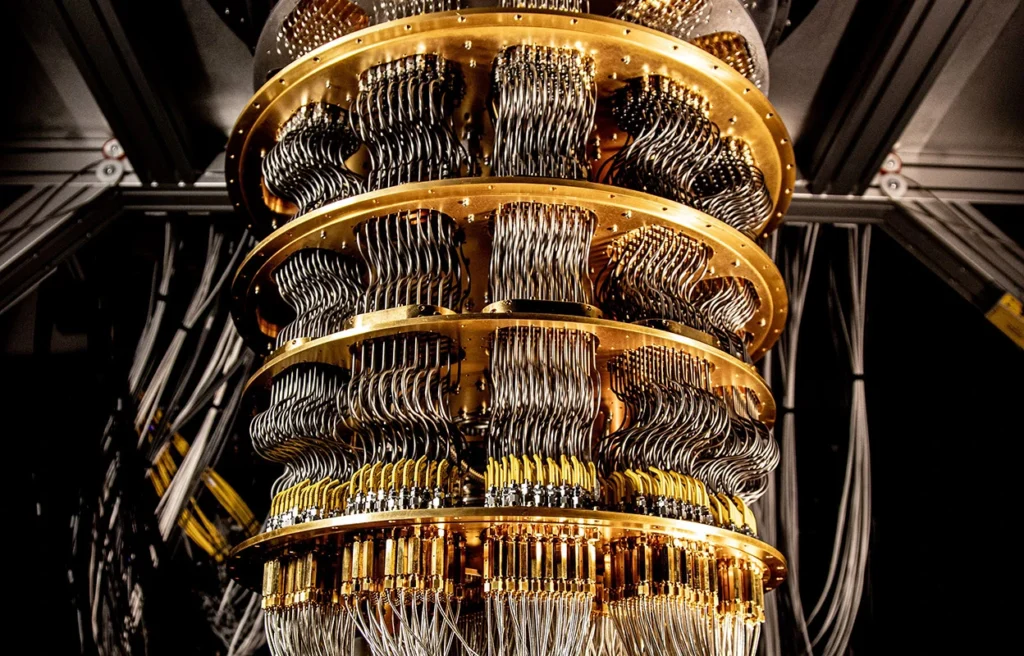
Side note, from this month I will try to use pictures “real” from the market because I started to find no excitement in having just AI-generated pictures that always look so similar to each other. One of these months is from Google Quantum AI (credit).
Please appreciate that this newsletter is manually written with the purpose of keeping content creation authentic and creative as much as possible.
Market evolution
So what did we see last December in the market, starting from the chipset evolution:
- Intel is still without a future permanent new CEO, being in a special situation that seems clear they missed the AI train, and it will be difficult to catch. Some chances could be related to some opportunities, like entering the game to manufacture the A20 Apple chipset, but it will be one small piece of the mosaic. On the other hand, it seems is not creating market interest for acquisition from Broadcom or Qualcomm, but the future CEO choice will give an indication of what will be the way the board will like to drive it (either really AI focused or M&A approach).
- We saw the US restricting China’s access to US chipset technologies related to AI to slow down China’s advances in AI, and the day after, China banned the export of key minerals to the US for chipset production in the US. I’m really curious how this is going to evolve during the next few months of the new US Government.
- In parallel, TSMC announced that in 2025, the production of new chipsets (which should include the 2nm) made in the US will cost 30% more than in other places due to the cost of chemicals. This is going to be an interesting challenge considering all the other issues related to the tariffs planned by the US, and it is going to require an important review of the sourcing strategy for the US. It’s interesting that just a few months ago, TSMC was announcing that the production in Taiwan would not be impacted by the change of cost from China tariffs, as I referred to in the previous month’s newsletter.
- Another interesting aspect about the TSMC situation reminds me of a former consideration I did a few months ago about the single point of failure in TSMC and the possibility of a market opportunity for competition.
- My Thoughts: Nvidia just announced start to work with Samsung, possibly shifting away from TSMC. That would be an interesting shift, reducing the risk of dependency on a single player, even located in a difficult area (Taiwan) vs South Korea, and I would consider this possibility highly interesting to focus also from an investment point of view.
- Qualcomm seems to be getting through the trial with ARM on the architecture ownership and will most probably win fully. This matches my initial prediction, and I expect the Qualcomm stock will ramp up, considering that the last few months were quite undervalued.
- NVIDIA, after passing in November as a capitalization Apple, announced in late December to enter the humanoid robotics market, more from an OEM level rather than direct robots implementation, so in this sense not competing with Tesla or Huawei directly.
- My Thoughts: I see here interesting aspects when we look the humanoids robotics from the aspect of Edge computing and using an AI chipset supporting them.
- Interestingly correlated to the Edge AI, STMicro announced collaboration with Qualcomm to build IoT equipment for Edge computing with AI, and this goes much in the direction of evolving IoT as I was referring to a few months ago.
- My Thoughts: It could be a good ramp-up for STMicro as a way forward. It’s also a shift from China’s automotive industry’s lowered demand for edge computing due to lower volumes.
- Still, the tariffs topics of US will be a big question for 2025. Some companies like Nvidia and AMD are rushing to import goods to US before the new regulations come into place, but this will only delay the real influence of the change that will happen.
- My Thoughts: If I were to guess, and please consider I’m not an expert on, Qualcomm stock will rise soon, STMicro will recover in the medium term, and Intel will take some more time, but will already get a good first ramp-up as soon as the new CEO is announced. NVIDIA is excited about the new diversification in the sourcing (Samsung as an alternative to TSMC) and reducing the risk of a single point of failure or sourcing bottleneck. I don’t mention other sectors where I see a high level of over-evaluation, but I limit myself to the tech environment.
Looking more into the crypto evolution:
- First, please consider that I’m not an expert; I just warn against meme coins. They have no intrinsic value, and we saw a few of them that raised 500% in 24 hours because some influencers sponsored them, but after a short time went down( the day after). This seems to me not the way to go; it’s like gambling.
- On the other side, Bitcoin has more structure and meaning, but it will be hard to double or more its value in the short term due to the already pretty high valuation, but the new indications from the US government investment direction will surely give a boost.
- My Thoughts: Alternative crypto, especially layer 2 and with a specific purpose like XRP for interoperability with banks or Cardano or Solana seem to me more interesting than just crypto without a purpose, like meme coins. Anyway are risky, volatile, and people should be careful investing in them.
- The energy consumption from crypto mining will be more and more of a problem. More in the environment section.
- Finally, I don’t want to speculate against but just warn that crypto, as well as modern distributed general ledger chains networks as the base of web3 applications and designed on blockchains, are based on the immutability of blockchains and the inability to detect the private key of each participant.
- My Thoughts: However, quantum computing could pose a challenge in the long term in the overall model, and until all blockchains are post-quantum encryption compliant, this could develop into a big problem. Definitely I don’t see this as a threat in 2025 but there are actually trends of investing in crypto currencies as long term investment strategy (10 years and more) with the idea to generate a strategic fund and in some countries there is who wants to create pensions based on bitcoins and I would warn that, apart the fluctuation risks and instability, it would be on top unsafe most probably unless quantum encryption level compliant.
Speaking about Signals of Crisis:
- We saw that after automotive and all the correlated businesses, the German market is also impacted in other sectors, for example, the solar systems demand decline either because the automotive crisis reduced investments in other sectors, or because Chinese competition with cheaper and good quality products is also in other sectors, like solar systems, as happened with the automotive sector.
- Where the EU market was mostly depressed by the automotive and its ecosystem, some other realities like SAP drove the German market, compensating for the loss in the more historical production sectors. I describe a little bit more in the Tech Companies subsection below.
- Some topics of data privacy touched VW recently about information leaks on the customers’ vehicle data. More in the section under Data, IoT, and Privacy.
- Also, Asia is not without crisis. Neijuan represents the buzzword that in China describes the crisis of employment and frustration that is experienced by GenY (Millennial) and GenZ. The crisis of markets, the acceleration of automation with AI, and the need for specialization in the usage of new technologies that are accelerating further, is creating a clear challenge in China, and that will enhance the push for getting new markets to mitigate the crisis.
Speaking about Tech Companies:
- SAP and its strategy for Rise as a cloud-first approach, together with the acceleration of renewing SAP instances due to the upcoming end of support of the former ECC, are bringing more value to customers, renovating, introducing more E2E business processes best practice redesign, and obviously, in enlarging SAP market adoption. The fact that SAP is now really going cloud is also showing in the paradigm shift of some capabilities, like Joule, delivered only on cloud, and Rise solutions. The introduction of LLM of Joule in day-to-day will have a potentially strong impact on the operations improvement and the embedding of agentic AI to it, especially starting from some basic processes automation, like in Procurement, will introduce a strong value-add opportunity.
- In the area of Sales platforms, Salesforce released its new Agentforce. We spoke about it in the former newsletters, so I will not get into it, but the potential in terms of the introduction of automation from an agentic approach is already pretty visible and valuable.
- Many movements in the agentic AI from big giants like Microsoft, Google, as well as innovators like OpenAI, Anthropic, are quite frenetic, but I will keep relevant updates in the dedicated section on Agentic.
- Microsoft just announced they plan to spend 80B$ in 2025 in AI datacenters, and that gives an idea of the sizing of that AI development still ongoing.
- Other areas of evolution are in the area of quantum computing, more in the dedicated section.
About general updates, Gartner made a nice summary of the main expected technological trends in 2025, ongoing, and I can share a few my opinions:
- Agentic is clearly going to be a big hype for real day-to-day operations improvements.
- An AI Governance Platform is a prerequisite to set proper boundaries of the overall AI and definitely of the Agentic.
- Post-quantum cryptography is going to be a must, and you will see that further touched on in my Quantum Computing section.
- Ambient Invisible Intelligence, especially linked with the Agentic AI and IoT, for different use cases of automatic stock checking, for example. Here you can see a list of some use cases I put together last month, specifically linked to Agentic.
- Energy-efficient computing will be another key aspect as crypto, cloud, and AI are increasing energy demand. In the following section of ESG I analyzed the update on this.
Environment, Social, Governance (ESG)
Some interesting updates also in the Energy market from last month:
- Russia is banned from mining crypto during winter due to the energy consumption.
- There is an explosion of interest in micro-nuclear plants that are going to be less risky (switch off in milliseconds) and able to produce where demand stays, or also some models like the Gates’ Natrium.
- As referred in the EU Crisis subarea, Germany is struggling with solar systems production, mostly due to competition from China, but the market of renewable energy is a big one further developing, considering also that 2024 was the warmest year from when measurement was taken.
Under the aspect of Social, specifically in the area of Smart Working and return to work, we saw a few things happening:
- In September, you will remember that Amazon was mentioning they were going back to work in the office 5 days a week from January, as I mentioned here. It seems that, anyway, this process will be somehow slower because in some places, is even missed the physical office space, yet.
- In parallel, Trump announced that federal workers will also have to be back in the office.
- Similarly, other countries, for example, the UK, have similar cases happening too.
- In 2025, it will be relevant to figure out how much the organizations will be impacted by new regulations and if employees will leave for other companies, impacting the overall company’s renewed policies.
Quantum Computing
This month I decided to put a lot of attention on Quantum Computing, which is, I repeat again, like I did over the last few months, at the early stage of its development and has a strong potential to develop over the next 5-10 years. You can read the former newsletters for some other topics that have been touched on or subscribe to my MacQuantum channel on LinkedIn.
However, a few things that happened recently justify the attention in this area for the upcoming 2025 and further:
- The recent Google Willow achievements in terms of error reduction show a tremendous acceleration in the Quantum computing capabilities in terms of the number of concurrent qubit effective computation. The error correction architecture evolution can allow for increasing the qubit maintaining reliability in the results within a decent percentage. This is normally one of the challenges as the number of qubits increases; they influence each other, and the systems reduce to standard computing in terms of efficiency. The actual results show the capability to keep the errors within a certain percentage, so as the dimension of the qubit increases, the overall scale rises, allowing the capability of calculus not possible with standard computation. It will be interesting to keep an eye on the development of this area and how much it will bring real capabilities to the day-to-day computation challenges.
- The growth of qubit computation capability will be a possible threat to standard encryption engines used over the internet, which are normally driven by an asymmetric encryption engine with public and private keys. This would normally not be attachable by brute-force in standard computation time, but this could be quite different in a quantum computing approach.
- As I described in another section in Crypto, the blockchains for Crypto, like also blockchains for web3 applications (like vendor sourcing material tracking in sensitive product markets), need to be built over a post-quantum encryption compliant architecture, or they could be, in the next 5-10 years, cracked and blockchain immutability compromised, impacting their basic purpose. These aspects are crucial to be considered soon to guarantee that the acceleration of Quantum Computing will not be a threat too early to the already running web3 applications on the market.
Data, IoT, Privacy
Interesting this month, some updates linked to Privacy in Data:
- VW, after its own problems with electric vehicles, got in the spot for the fact that around 800K electric vehicle customer data were visible on the internet without any encryption. Here are several topics, one less relevant due to the fact that so much data was shared. This is less relevant because, at a certain level, the people agreed to share some level of data even if they obviously didn’t expect it to be public. The big element is that the fact that they were completely accessible over unencrypted online sources and allowed to create correlations and identify persons, even with email, vehicles, and locations where these vehicles were over many days and months. This poses a critical element about which data we share with whom and for which purpose, and how the data is maintained. The more progress around global platforms develops, the more we have to maintain a proper tracking of the overall data flow between applications, customers, and vendors in a structured and up-to-date way.
AI
This month we see the Agentic approach progressing further from my initial updates of a few months ago. Just over last month:
- World Economic Forum published interesting recommendations about how Agentic would improve different operations use cases.
- Google pushed the Gemini 2 ecosystem for the development of agentic AI.
- Microsoft, SAP, Oracle, Salesforce, ServiceNow (just to mention a few big ones) have already released products in the agentic area and are accelerating as other producers. Some other players, like OpenAI, are releasing their first products in January or soon after.
- Also in the area of cybersecurity, clearly agentic is already promising acceleration of prevention and response, and we will see updates heavily as well in the area of threats.
- I analyzed a few easy use cases for day-to-day, risks, and tips as recommendations. Here you can find them.
Then on the Robotics is interesting to see some developments:
- NVIDIA entered the humanoid robotics, not competing with Tesla specifically but creating more a framework for different producers and forcing the AI chipsets as a component of the edge AI that would be critical for the humanoids as well as for automotive and progressively IoT.
- My Thoughts: One of my typical speculations/imagination. I see the possibility that humanoid robotics is going to combine with Agentic as a possible future approach for repetitive activities, also including robotics/physical actions.
Cybersecurity
In the area of cybersecurity, there are clear effects of AI accelerating:
- The trend of AI and GenAI is accelerating the phishing capabilities, including the evolution of video deepfakes used actively to attack corporations.
- The AI is also going to allow to accelerate aspects of prevention and automatic response, especially in bundling with Agentic, reducing the time to tackle cyber cases, but also accelerating the way to attack.
- As McKinsey reported over the last month, there is an acceleration in cybersecurity with AI (on both sides)
- It’s interesting to see from the report also the balanced percentage of security spending outside the CISO budget area and how much of the IT security is landing in the cloud security (the first category in spending outside the CISO budget). This is also an aspect that is especially sensible from my perspective because, as clouds and AI develop, new threats get exposed and can be easily applied to other customers of clouds.
- IoT is indeed one of the least standardized parts, as visible also from the analysis of the McKinsey report, and cybersecurity, especially integrated with AI, will have an opportunity to leverage some level of harmonization on a layer still quite fragmented.
Wishing you a great start in 2025!
GG