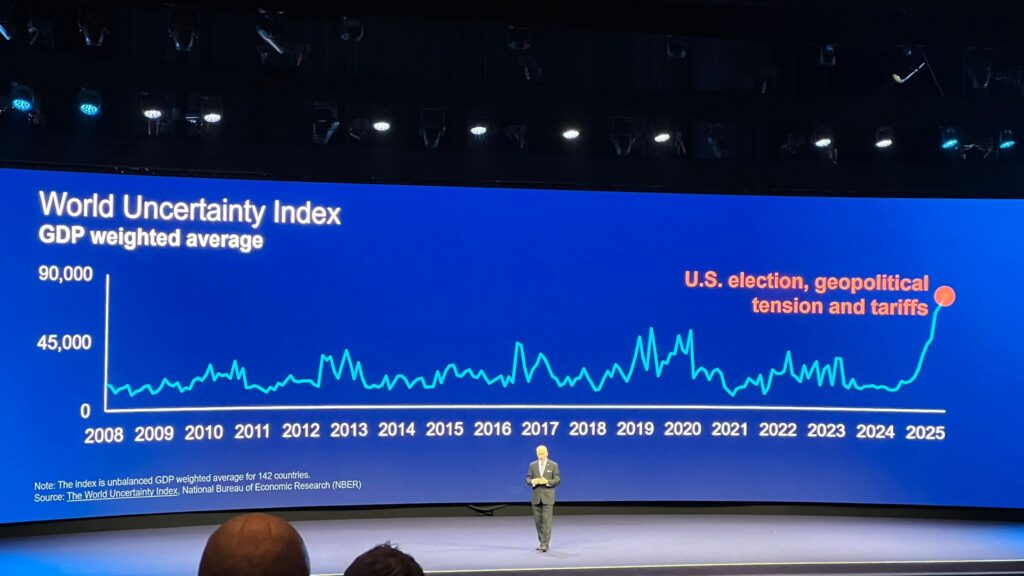
I’m taking this month a view as usual on the different dimensions we monitor, but keeping a special attention to how the world uncertainty is influencing those areas more and more.
The picture I’m using this month is from the recent Gartner Symposium 2025 in Barcelona and is taken from a great presentation from David Furlonger. This specific picture, I think, reflects more than 100 words and pictures about where we are in the world today and gives a perfect understanding of how complex this is, influencing aspects related to business transformation that require long-term investments in an uncertain time.
Following a conversation started a few months ago with blackout touching countries, we have seen service unavailability from big cloud providers due to extreme automation impacting operations.
Most recently, after posing the question of overall internet accessibility problems, I’m then questioning one more time the attention on how AI has to be built properly to bring value with automation to avoid to run in operations problems.
My focus will then be to relate as usual on how we are developing the key areas I track and how the tensions are influencing them.
This is a long-form newsletter, hand-written, speaking about inflection points influenced by technology. It’s based on articles I find relevant to share and is infused with my thoughts. It’s for critical thinkers who love to hear complex correlations, self-reflect on the consequences of trends, and exchange opinions on how to tackle the best possible approach for the future.
Quick Executive Takeaways
Key technology priorities to focus on for your business based on the latest few newsletters’ perspectives:
- Offshoring rethink: Evaluate if it would make sense to insource back, influenced by geopolitical threats and easier automation of processes with AI. Opportunity with customer services, service desks, and shared services
- Software Development: Improving the usage of AI, reducing some of the most repetitive manual activities not yet automated
- Agentic AI: Build and execute a roadmap over the next 12 months for non-core business processes to shift to autonomous agentic, having clearly in mind S.M.A.R.T. use cases with acceptable ROI
- Clouds: Review strategy in consideration of geo repatriation due to foreign countries’ threats
- AI Roadmap: Prioritize governance around guardrails and cybersecurity
- Learning Platforms: Time to consider moving to AI-supported platforms
Market Evolution
Chipsets & semiconductors
Nvidia & TSMC
NVIDIA, over the last month had some stress tests on the stock market as there is attention from investors to analyze the results of the quarter as an indication of the trends from the AI market and how real and fast the AI bubble is growing. However, over the last year, I described in my newsletter that Nvidia, with its advanced ecosystem of chipsets and libraries to deliver on AI, created a dependency for many cloud and AI providers, depending on that stack for their own AI roadmaps. In parallel, the new US administration generated an extra level of influence on which technology could be exported outside the US and how, with key restrictions on most advanced chipsets models that I reported over many months, also related to TSMC. This included adopting approaches demanding part of the revenue realized with some countries like China on selling AI chipsets, restricting the export of most advanced technology of those chipsets, enforcing to build most advanced 2.5 nanometers manufacturing in the US, and many more regulations to try to keep sovereignty on AI within the US. As we analyzed over the last few newsletters, the back and forth, most recently changed again approach on allowing export is not creating stability in long-term strategies for technology that is required to build consistently stack of services. Reality check shows that China started to build its own AI chipsets and started to force organizations to use its own capabilities, from Huawei, for example, but also most recently from new players, as you can see in my former analysis.
At the same time, the complexity of delivering the most advanced Taiwan production processes, like 2.5nm, is also influenced by the environment and cultural aspects, showing the challenge for realities as TSMC with customers like Apple and Nvidia, while trying to enlarge production in the US and struggling with the differences over many aspects to execute such a shift of center of excellence. The New York Times made a good analysis in this article. Reality shows that making a production shift from one side to the other of the Pacific has to do with finding and skilling a proper workforce, managing different regulations in work and restrictions on pollution and land usage, including also aspects of resource availability like water, highly needed for such a type of production, and definitely with different abundance over the two contexts.
When a challenge comes from the single sourcing, it’s also the time when alternatives can come and impose as an immediate alternative. China has proven in the past to be able to build LLM without the most recent AI chipsets from Nvidia, but with similar results (like with DeepSeek), and most recently, Google has proven to be able to build its most recent and outperforming Gemini 3 only with their own tensors chipsets and no dependency on Nvidia architecture.
Big Tech
OpenAI
Just last month, we discussed how many investments OpenAI made to differentiate its sourcing for cloud and chipset providers to be able to expand with less influence from the scarcity of specific vendors. In less than one month from those searches for funds, as I mentioned earlier in this newsletter, Google ramped up with its new model Gemini 3, behind the scenes trained on 2024 datasets, and showing a step up in terms of reasoning and long-term chains. What is most interesting from my angle has been the paradigm shift in which Google has proven to deliver a model using its own tensors chipset and reducing dependency on third parties. This is a powerful change of pace, showing that most advanced models can be built without unique Nvidia capabilities and compensating with other approaches, reducing the need for over-demanded and export-control freak components. Such a change of paradigm can be relevant as Deepseek was earlier in the year, and is showing new paths and alternatives that can be even faster and more reliable.
As a consequence of a highly competitive market in top AI developments, in less than a few days from the Gemini 3 release, Salesforce’s CEO, Marc Benioff, announced his endorsement of Google, and Sam Altman pushed for a code red call to his company to focus only on the most relevant model development and leave the rest aside.
Microsoft
In such challenging times with different vendors owning new specific models, Microsoft, which, as we mentioned in previous months, is building its own LLM, is still highly dependent on OpenAI and most recently extended its own foot with Anthropic Claude. In such conditions, the focus stays on pushing toward customer flexibility, for example, accelerating the introduction of the localization of processing of data in AI within a certain geography for the purpose of digital sovereignty and providing progressively more LLM models to consume from.
Meta
Parallel, Meta is seeking Google AI capabilities to diversify from Nvidia, showing a risk appetite reduction but also showing an increasing dependency of different big techs in the US between themselves.
AI Investment Bubble?
As I mentioned also in the past months, we can see an increase in AI bets in 2025 for big techs, for a total of 400B$, doubling the 2024 investments, even if there are clear signs of a certain level of circularity in investments that could accelerate toward a bubble.
Digital Sovereignty
EU acceleration
It’s not a surprise to see an acceleration of sovereignty around EU. First SAP, as I mentioned a few newsletters ago, now also Gartner is paying strong attention to cloud geopatration, representing a push toward more independency even if recognizing that complete independence will take years to be achieved, as depending on a complex stack of layers today, highly dependent on US proprietary technologies. This is also as shown from integration partners like Accenture, showing a range of more than 60% EU organizations seeking some changes in this direction in the next 2 years.
Parallel to this, the EU industry is pushing for a Chips Act 2.0 to create some level of independence also at the lower stack level. If we reflect on my newsletter of one year ago, referring to Intel and its investments in Germany, which never really materialized, this is a shift to invest more in EU capabilities, with companies like ASML being indeed a center of excellence in the field in EU.
As mentioned earlier, some big Tech vendors like Microsoft are playing the card of computing data with AI within sovereign zones, and there is a push for sovereign cloud around the world.
Similarly, NATO pushed recently for EU sovereignty in terms of Cloud, Edge, and Quantum computing, and this is both an opportunity to develop more tech capabilities in the EU, but also a threat to make them really independent. It’s only a few weeks away from the recent Cloudflare issue that has shown how fragile the overall Internet can be, and the services we consume as part of our business and personal activities.
AI
Machine Learning, Agentic, Data
Agentic AI
In the area of building capacity in AI, there is an acceleration around Agentic for executing autonomous actions in business activities. We saw that platforms like Salesforce accelerated several sales processes, and SAP introduced capabilities in procurement automation. As I mentioned months ago, there is a clear development still in the early stages in terms of multi-AI agents orchestration.
To grant a stable agent interaction between different vendors and create a secure and stable collaboration without impact on supply chain reliability, there is a strong work around governance, especially on cybersecurity and guardrails to set. One interesting work in this direction, for example, from Fujitsu, goes much in the direction of a secure trusted chain for collaboration, including capabilities for shift of a piece of demand, bringing a dynamic Supply Chain approach to use in cases of emergencies.
So what?: Indeed, in June I speculated on the rise of a sort of collaboration trust between suppliers and clients, building a trusted collaboration agentic that would require building a proper trust between the parties, embedding also aspects of cyber and operations continuity, as would influence more deeply than former integration approaches.
Workforce Transformation
Workforce reduction
Layoff due to AI vs Upskill
There is an ongoing dispute about how many jobs get erased by AI and how many are instead from high-cost-cutting initiatives driven by an uncertain market. Definitely, some tech companies are changing their skin, trying to transform into what they do and how they do, and are in high demand for AI-savvy tech people. When we look at companies like HP, that recently communicated a 6000 employees layoff, if we dig into the causes, this seems related mostly to the raised cost of supply chain suppliers’ parts impact on their margin, probably also driven by tariffs, as we know, causing a complex cost increase in all the assembling processes. Assessing the details suggests that a focus on suppliers’ costs is one key piece of the cause. Another piece is linked to reducing customer support, which is indeed one of those areas that can benefit from automation with AI, but others seem driven by other causes, too.
Looking at other companies like Allianz, they announced around 1800 job cuts, mostly in call centers, due to automation. I recommended last February, around one year ago, to consider that call centers would automate, as that was already a quite clear process to optimize with AI. This is a typical example often already well formalized, because often partially outsourced, and so shifting between the option of outsourcing further or rather automating and keeping ownership was an obvious possibility. This can also be a way that the outsourcing gets eaten by the autonomous agents, as mentioned a few months ago here.
Some other companies, like Amazon, drove job cuts mostly as a result of resizing after COVID-19 hiring, but also introduced some automation in the corporate sector thanks to agentic.
It’s no news that Amazon is accelerating its own solution in the direction of automating coding, and that can optimize part of the workforce in place.
Workforce Augmentation
Upskill and reskill
An interesting statement from Gartner recently described that the number of jobs eaten by AI will be irrelevant, but a big wave of upskilling needs and job chaos will come. This is also aligned with the big shift in job types that WEF announced early in 2025 over the next 5 years.
Some companies, most advanced in tech, accelerated some job cuts, partially due to over-sizing during COVID, partially due to automated processes, partially due to the minor effort in some cases to hire AI-savvy rather than upskilling part of the workforce.
Clearly, as we progress during this major transformation, we will land from my point of view in a polarization, a little bit like the digital divide between former generations in using technology and resisting it. In such way will be much more specific on the way to execute jobs with the augmentation of AI or without. This time, in which companies still have a focus on upskilling resources, will be vital to take the chance to increase competencies that in five years will be simply expected to be present in each employee.
The more AI use cases will get more precise ROI, the more some transformations in the way people work will happen, so is relevant to think in advance where to put one’s own energy and where to give to an autonomous agent redesigning organizations around what makes sense they do and what to shift to AI as more efficient. In such a change, cultural change will be the way to drive communication at the leadership level to execute a proper transition toward a future AI-augmented workforce.
GG