The first month of 2025 has already passed, and it’s incredible the number of things that happened in the Technology field, and I see more and more correlations to come.
As usual, a summary of what I will write about in this newsletter. I will do some updates from the tech market trends, highly influenced recently by the upcoming tariffs communication from the new US Administration, as well as the export restrictions for AI chipsets, especially to China, and finally by the recent communication from Chinese Deepseek of the innovation coming in the AI world, potentially game-changing the investments of the US Big tech in AI.
Few relevant updates in the ESG part, considering some of the progress happening in the energy, and some changes that are happening in the Social part.
A general refresh on the AI part, also considering the news released on Agentic and some interesting hints in the area of Cybersecurity, especially related to post-quantum cryptography (PQC). Clearly the AI is so wide as conversations that I’m just trying to make a super-digest of few hot topics but there are tons of relevant topics in this field so feel free to suggest to add for the future more focus on specific areas if you like.
I decided this month to have the theme of the newsletter using as a picture the Davos World Economic Forum (WEF) 2025, and instead the title is taken by the Doomsday Clock 2025, which was just updated on the 28th of January. There is some antithesis between these two events in terms of focus, but there is also a certain correlation, as they both look at risks and how the world is developing. I will have a section below as special where I will pick a few takeaways that I see relevant from both events and relevant to technology.
As usual, I will build more ad hoc articles as we go, to deep dive into specific technological topics.
This is a long-form newsletter, hand-written, speaking about inflection points influenced by technology. It’s based on articles I find relevant to share and is infused with my thoughts. It’s for critical thinkers who love to hear complex correlations, self-reflect on the consequences of trends, and exchange opinions on how to tackle the best possible approach for the future.
Market Evolution
Let’s start speaking about the progress in the chipset market:
- On Intel, some new rumors about Qualcomm buying together with GlobalFoundries and Musk facilitating came during last month. Intel had some improvement during the month, but then went again into its difficult phase, considering also that the CEO is still missed from last December, and the feeling I have is that the situation goes more toward an acquisition process rather than trying to revamp the company by itself.
- My Thoughts: Qualcomm could ramp up as the ARM case would be solved, and a consolidation with Intel could come.
- The Intel rumors are correlated to many interesting movements we have in the semiconductor market in terms of control of technology. TSMC, you will remember I spoke in my former December and November newsletters, planned initially not to produce the 2nm outside Taiwan, and was not considering the increase in raw materials’ initial cost as a possible impact on the pricing. TSMC is always highly influenced by the US regulations, considering this market one of the most important and, again, in my former newsletter, I mentioned how they worked over time to avoid any sanction by the US administration, respecting the ban on exporting their technology to unfriendly countries, like China. Now TSMC is communicating that the production in the US will raise the cost for around 10% of their semiconductor and opened to produce the 2nm in the US, when, just in November, they announced a plan to keep 2nm in Taiwan only. In parallel, they announced that by 2026 they will produce the 1.6nm, but it is not clear to me if this production will be only in Taiwan or also happening in the US. Considering it is not a major architectural change, I would expect will be also happen in the US.
- My Thoughts: The US Administration is to push hard for revamping the Intel production of semiconductors in the US, embedded in the Qualcomm production, and reducing their dependency on TSMC, which is known to be a single point of failure in the semiconductor supply chain (also serving Nvidia and others). Clearly, the advanced technology on 2nm from TSMC is an advantage they have at this stage versus Intel and Qualcomm.
- The AI Chipset export restriction from the former US Administration is going to be an interesting influence on the future. Within 120 days of the release (mid January 2025), it will go live, and the plan is to slow down the AI predominance in other countries that the US doesn’t consider friendly, limiting the export of the most advanced AI chipsets. So most of Europe, South Korea, and a few others are considered friendly, some are neutral, with limitations (surprisingly, Switzerland is one of those), and some others are unfriendly (like China). It’s interesting that, anyway, the US tech companies that will build datacenters in some of these countries will not be under the ban limits but will have an authorization to export AI chipsets for their purpose. It’s interesting to see what the new US Administration will do around this. The recent Deepseek progresses have proved that a country like China is going around restrictions, developing innovation even with former technology, and apparently at a fraction of the investment of the US.
- I will speak more about Deepseek in the AI subsection, but then I will plan a dedicated article with a deep dive into the future. Here I would like only to mention that the impact on the announcement of Deepseek, able to produce an LLM, comparable to OpenAI with only 50M$ (including all the costs of training and so on) and with old AI chipsets, created a market earthquake impacting partially the big tech, that are investing in AI and especially Nvidia that is supposed to be a big producer of the most innovative chipsets
- My Thoughts: Big tech could have a big advantage by the possibility of achieving more AI progress with smaller investments. Google Gemini and Microsoft AI could charge much less for AI solutions if they were able to find ways to optimize their future investments. Some big investments in new datacenters could be reduced, or at least delayed (considering Jevons paradox), energy consumption raised due to new datacenters could be limited, and AI cost for end customers could be made more competitive. So far, if all is confirmed and easily reusable, it’s going to be a game-changer from my perspective.
- NVIDIA has fallen heavily over the month. Different reasons, clearly driven by several aspects, not least the Deepseek news, are reducing the future demand of the newest AI chipsets.
- My Thoughts: Nvidia could continue to struggle to raise their value, that was already over-evaluated from investors recommendations but other tech, higher in the value chain, like Microsoft, Google, Amazon, will ramp up again because they would have a big advantage to achieve more AI innovation for a fraction of the cost, also considering that a solution like Deepseek is open source so will be accessible to big tech the overall model optimization in a short timeline. The question is whether there are hidden secrets or unsaid things behind all this new solution.
Looking more into the crypto evolution:
- So what?: I guessed in former newsletters that XRP, Solana, and Cardano would rise. XRP over the last month raised more than 40%, Solana 26%, and Cardano just 5%.
- As I write in my disclaimer, I’m not an expert, and I speak about some of these only for conversation. The only thing I insist to avoid are the meme coin investment. Meme coins are like a lottery. You put money, and only a few win, and normally, those “big whales” that are early investors and going out as soon as small investors are in. On top, there is no intrinsic purpose for them. They are useless, so their value is limited to the fact that some people are buying them. The recent $Trump is a good example. No usage for anything, raised 16000% in 24 hours, and then lost more than 50% of its value. Many small investors invested just shortly after the announcement, but it was already slowing down and lost considerable money. These solutions are also hiding the high costs of transactions and on exit. You can check if you open a wallet and try to monitor the high cost of purchasing or selling. Please consider that it is really gambling. At the end, these are going to be, from my point of view, like Ponzi systems.
- Bitcoin will continue to rise, but don’t expect to see them raising a lot in the short term. It’s not easy to go to be 500% in a short time like new crypto due to the already high volumes and value. Definitely, as soon as investments in Bitcoin from governments are published, it will be a big raise.
- My Thoughts: I think that Crypto with low energy consumption, so not based on the algorithm with high energy consumption for consensus, could be the future ones to rise.
- Question on Quantum computing cracking of crypto and blockchains will remain for the medium term (5 years) for those blockchains that are not upgraded. It’s not a problem of today, but it is going to be interesting also from a cybersecurity point of view, and I will discuss it in the dedicated section on how post-quantum encryption is going to impact the ecosystems of applications to update in the companies in the next 3-5 years.
- My Thoughts: XRP could continue to raise but I’m not sure how much. It could make a next ramp up to 4 or 5$ in the next few months, basically doubling again. Bitcoin, I would guess up to 180K$ by the end of 2025, but it depends on how much they will be used as long-term (10 years) government investment. Solana, which is used for most of the meme coins as a blockchain, can continue to grow because of the many memes that come out every month, so I would guess still a good 20-30% before the end of 2025.
Environment, Social, Governance (ESG)
In the Energy world is valid to mention:
- In the long run, the progress, again from China, in the area of nuclear fusion. This time went more than 1000 seconds, versus the former record of 400 seconds in 2023. It seems now getting more and faster. Curious to see where we will be in 10 years, but it will definitely be an interesting future trend.
Under the aspect of Social, in January, we saw a few shifts in US enterprises:
- Meta, JPMorgan, (just to mention a few) went away from smart-working, and many other business as well, like McDonald’s and others, reduced their DEI practices. It will be interesting to understand how the tech market demand will be influenced by this shift and how this will influence some jobs that have been shifted to teams completely remote. What will happen with completely remote contracts? It’s interesting to understand if the back-to-office will force some teams to pretend to have remote workers in the office too.
- Many social companies, including Meta, one of them, announced the stop of fact-checking, embracing a strategy to leave the news flowing without any level of filtering. Now newspapers are, in general, appreciating the fact that they will most probably going forward to be the ones doing fact-checking, and they could position themselves to be the only source of truth on official information. All will depend, from my point of view, on what will happen with unreliable information that could flow in the future in the socials and what could cause that from who is making publicity.
- My Thoughts: I’m curious if the changes happening in the “back to the office ” approach will also influence a reduction in usage of some of the online platforms, like Zoom or Teams. Clearly, few like Teams translated to be a sort of entry point for many activities to work, but more vertical solutions could have an impact on how many calls people would make. On the other hand back to the office didn’t influence the back-to-travel for business as before, so maybe the target is anyway different than the starting point a few years ago.
AI
In the area of AI is always a big set of things to share and more to filter out. First of all, some general updates:
- The boldest announcement in AI has been initially the one from the new US Administration with the Stargate project for 500B$ to rise AI and having in the loop OpenAI, Nvidia, Oracle as main players and behind obviously the other big tech, including Microsoft (that has a say with OpenAI).
- Immediately after was the reply from Musk on the fact that the Stargate project would not have enough funds to execute, also driven by his conflict with the OpenAI CEO, Sam Altman, followed by Trump minimizing the conflict.
- Recently, Deepseek came out, revealing that an LLM could be built with 50M$ (including training) and using older AI chipsets. The Chinese start-up got famous on the market, as they were already known for their work earlier, but got bold during the release of the R1 version, competing with ChatGPT O1 for a fraction of the cost. On top of the fact has been released as open-source is making it much more possible to learn and replicate some of the strategies adopted. For example, one element I identified so far is the usage of a caching mechanism, identifying that in requests, most of the parts are often repeating and avoiding requesting at each reiteration, causing an optimization of up to 90% of the performance versus without cache. I will deep dive into the mechanism in the future and will come out probably with an article. I also suggest being consistent in reviewing the architecture, the improvements, and the reality of the overall cost before underestimating every alternative. Clearly, this scared the markets, and there were quite a few attacks to try to put down the service after the announcement.
- My Thoughts: There will come no surprises from the solution with hidden costs or limits; this will definitely reshape and introduce improvements in the overall picture of the AI investments. I suspect this will cause a reshape of the funds needed to transform (so Stargate may not need 500B$ to go) and will allow to introduce a more wide access to AI capabilities for a wider market at a fraction of the cost, making the AI much more pervasive and for everyone. Clearly, the datacenters’ explosion is expected to continue to happen, but maybe at a slower rate, having so much more capacity delivered by the same technology. It’s interesting anyway to have a deep dive and see how much of that solution hints can improve the other strategies.
In robotics, some interesting updates:
- China is ramping up the production of humanoid robots and is also having a mixed marathon in April with people and robots. It seems a time for ramping up humanoid equipment for human day-to-day operations.
- My Thoughts: The rise of agentic, as I wrote last month, together with LLM and mini-LLM working on the edge without the need for cloud, thanks to newer AI chipsets, could accelerate the evolution of robots to interact with using a natural speaking language and be capable of doing some basic autonomous activities. This could help in manual, repetitive activities, not only virtual but also physical.
In the LLM and Agentic AI, we have seen a few more things:
- OpenAI released its Operator engine. I spoke some time ago about some Agentic use cases, like the one that Operator is going to enable.
- I’m thinking today about automation activities more related to purchasing online services, like hotels, airplanes, and products, but tomorrow could be used for more integrated processes like job applications, complex procurement automation, and so on.
- Google pushed for the introduction of Titans as a new architecture with long-term memory. This will definitely enlarge the capabilities of agents to act autonomously.
- Expecting many more updates during the upcoming months.
Cybersecurity
What I see here relevant this month is about the Quantum Computing risk:
- Gartner is accelerating on the aspect that asynchronous encryption must upgrade to PQC (Post Quantum Cryptography) within the next 3 years. Now is realistic that quantum computing will be able to break actual asynchronous encryptions not PQC-compliant, within the next 5 years. The challenge is to work around identifying key applications to upgrade first to PQC and, in some cases, understand if that capability is even available for some of those. This includes not only applications but also bare infrastructure that needs to upgrade its level of encryption to be PQC-compliant. Such types of investments are huge and difficult to justify from a business point of view. They are just risk-avoidance driven. Gartner mentioned this as a level of effort comparable in the next few years to the Y2K (The Millennium bug) effort that happened in 1998-1999. I remember I was at the university at that time and the hype for it and the money invested were huge! Also, Moody raised the concern of PQC as real problem and started to raise their concern
- My Thoughts: Companies could fail to detect the challenge of PQC underestimating the risk versus the effort and decide to shift later, landing in a situation of exposure to risks much wider. The horizon is 4-5 years, and because it will require a certain level of investment every year, including a proper consolidation of applications and infrastructure to transform, it’s not going to be a task that can be shifted to start in few years.
Special – WEF 2025 & Technology Takeaways
Last month we also had the WEF, and it is interesting to identify the technological takeaways that were most hot in the conversations:
- Many CEO raised attention on the US tariffs that would impact the EU. This is relevant as discussed before in this newsletter, for example, with the aspects related to the export of semiconductor raw materials and the overall cost increase
Let me first extract what I took as tech takeaways from the two events, and then at the end, some of my considerations.
What summary in tech is relevant to the Doomsday Clock?:
- On the 28th of January, the update bulletin for 2025.
- Biological threats from emerging diseases are being built by terrorists using AI to build new biological weapons.
- Concerns about climate change were also accelerated by relevant countries not giving the proper importance
- Concerns about nuclear weapons risks linked to wars and to how many countries own nuclear capabilities
- AI is used for military weapons, and concerns about their autonomous decision-making.
- Spread of disinformation also uses AI to make them more realistic, including the use of social media to exacerbate them.
- So what? It was in January 2023, after ChatGPT was released in late November 2022, that I remember I first posted my concerns on the rise of deepfakes and disinformation thanks to AI. I also made an article at that time on that for the MindForIT subscribers.
What summary of tech relevant from the WEF 2025?:
- There has been discussion around AI Agents and how to make them more autonomous deciding, taking examples of robots in this sense. Nice video here.
- Impact on supply chain reliability due to cybersecurity, for example, with purpose attacks impacting on weak nodes or feeding with AI poisoning data, and in general on IT fragility not driven by cyber, taking also examples like the Crowdstrike of last summer.
- Rise of mining also through AI with full autonomous mining, while also introducing more recycling in the overall process, reducing the overall waste.
- Clean energy production, especially the example of Solar in emerging countries and development with big investments combined with AI to decarbonize the energy sector in the UAE, providing, for example, Abu Dhabi ADNOC to reduce its carbon footprint already.
- An interesting overview from PWC based on surveyed CEO on the fact that many businesses over the last 5 years entered at least one new sector where technology is playing a key aspect of the major reconfiguration
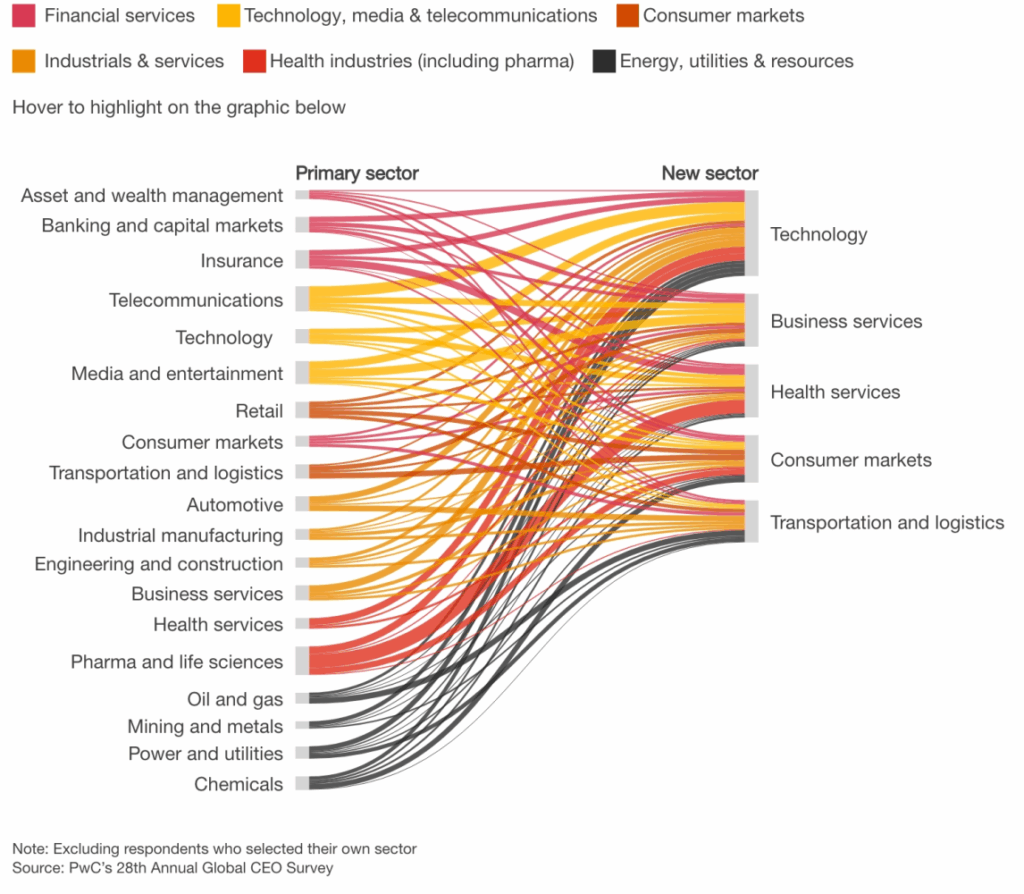
- It’s identifying the benefit of introducing AI in the technology platforms of enterprises, bringing automation to some activities. That trend is already visible in many cases of the agentic and former automations that have been pushed by many tech businesses. However, PWC reports that from the survey to CEO, around 30% have little trust in embedding AI in the core business processes of the company.
- Governance around AI, especially linked to agents and autonomous actions.
- The Future of Jobs Report – WEF 2025 is a relevant report built on more than 1000 people surveyed, leading companies with more than 1.5M employees. It’s interesting to analyze different dimensions like sectors rising and disappearing, countries’ distributions, and skills change. It will be valid to make a full, detailed report showing how the technology is influencing the overall job evolution, digging into the whole report analysis, so in case you would find that interesting, just comment asking for it on LinkedIn, and I will consider doing it eventually. Meanwhile, I give some short notes and correlations based on a bird’s-eye view:
- 170 million jobs projected to be created and 92 million jobs to be displaced, but I didn’t find in the report the time distribution of the creation vs displacement, or in other words is not clear in which order they would foresee that to happen so I suspect the order is not set but definitely relevant because displacing and creating later would be much different impact.
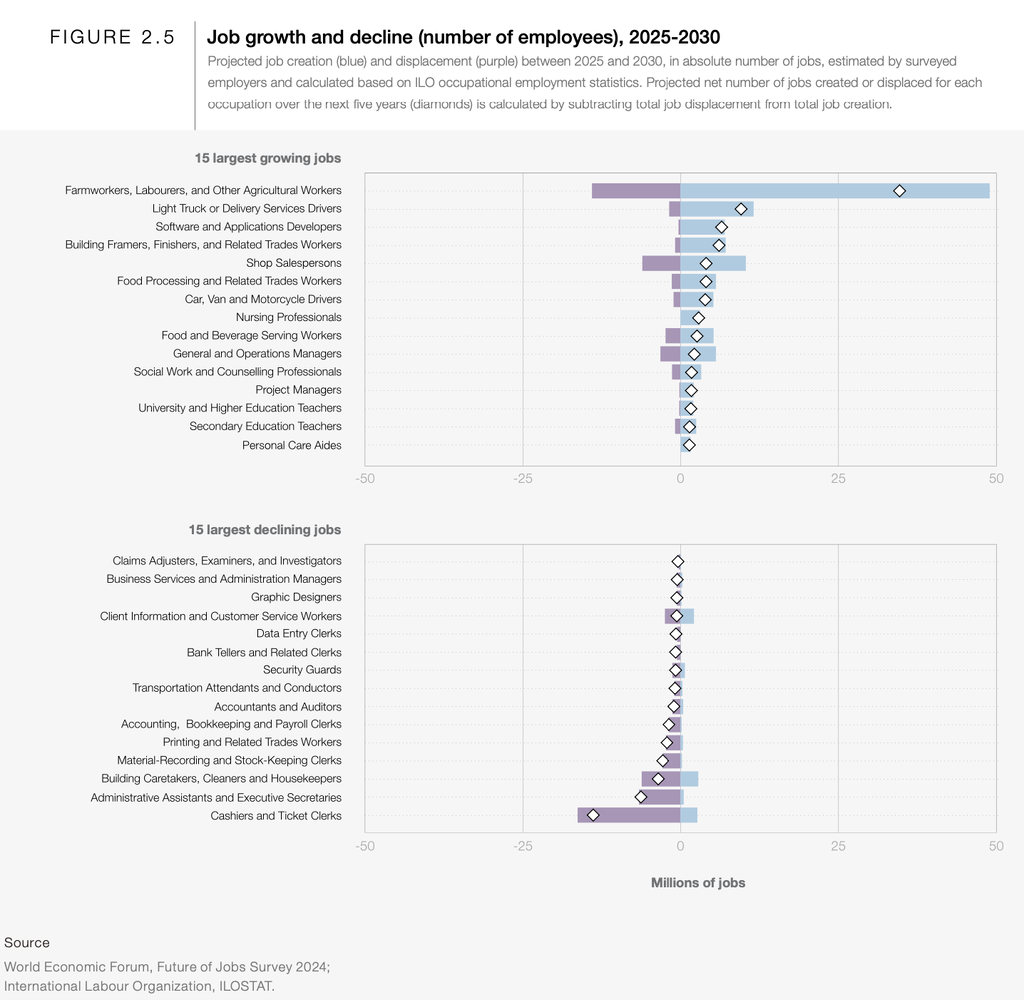
In this example, we see a big transformation happening, for example, in “Farmworkers,” while also several former jobs are removed. Upskilling will be crucial and happening in the same area of competence, but with more innovation and automation. When I look to some of the announcements, for example at Davos, Laurent Freixe, CEO Nestle reported on their investment in the innovation in the Agriculture sector, for example, with regenerative agriculture and in the next generation of farmers and effects on the climate as introducing approach to sequester carbon and more recycling and these are signals of how much Nestle is driving toward the transformation.
Some other cases, like “operation and general managers” and “Shop Salesperson” are getting replaced and increased with probably augmented competencies. In some cases could mean people changing businesses and upskilling in the process.
Where jobs get removed and not created further is in the area of cashiers and administrative tasks, including executive assistants as well, in the building and cleaning activities. That is where the major upskill will require a shift also of area of competence because those resources will have to shift to different roles, meaning more effort to fully reskill. There are also relevant roles of stock record roles that are going to be fully automated and will disappear. Indeed, already in many areas there is a big opportunity with technology to fully digitalize and automate the stock management.
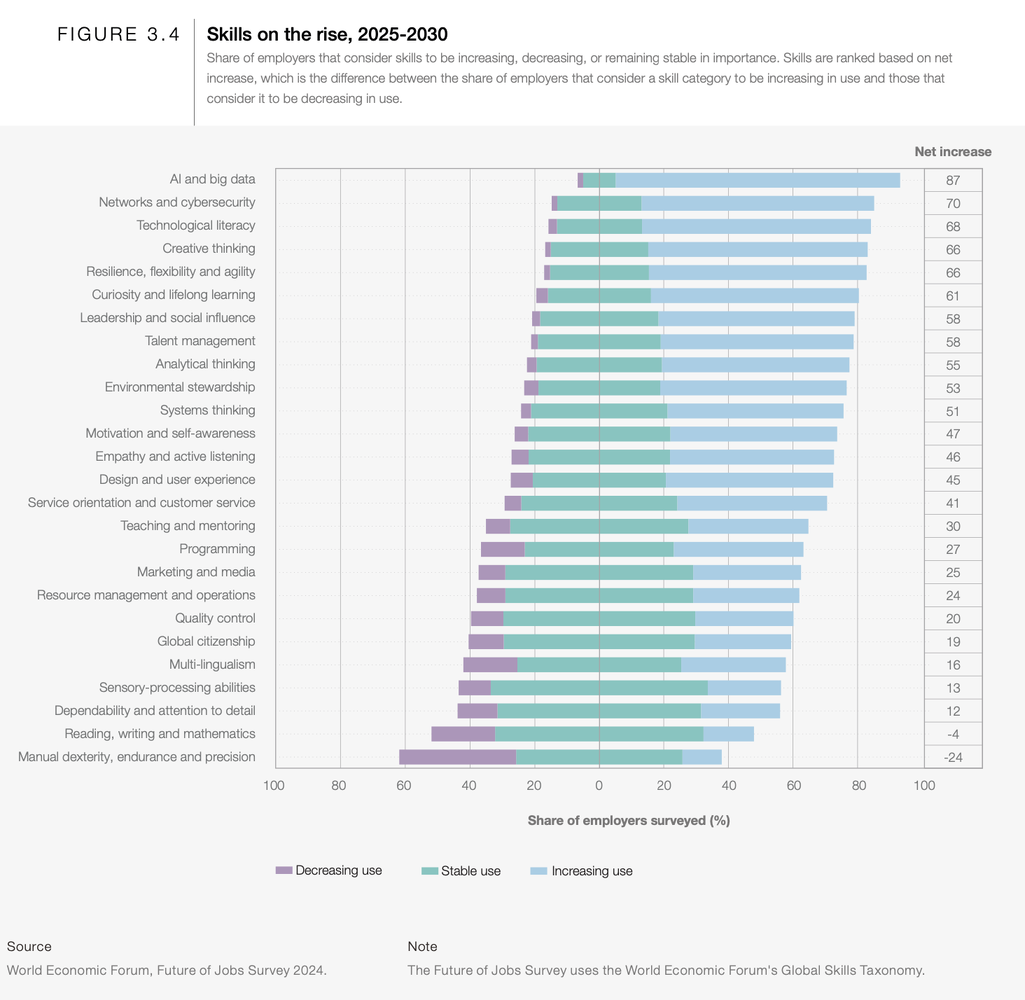
The major skills change is going to increase in the area of AI and big data, and decrease in the manual tasks. Here I put maybe some doubts on the overall assumption because for example the reading, writing and mathematics look less relevant where AI is more important but considering that ML (Machine Learning) a fundamental branch of AI is highly based on mathematics (matrix and tensors) and bigdata as well is highly regarding statistics and again is mathematic, maybe we need to understand the interpretation of some of these data also depending on the target audience of the survey.
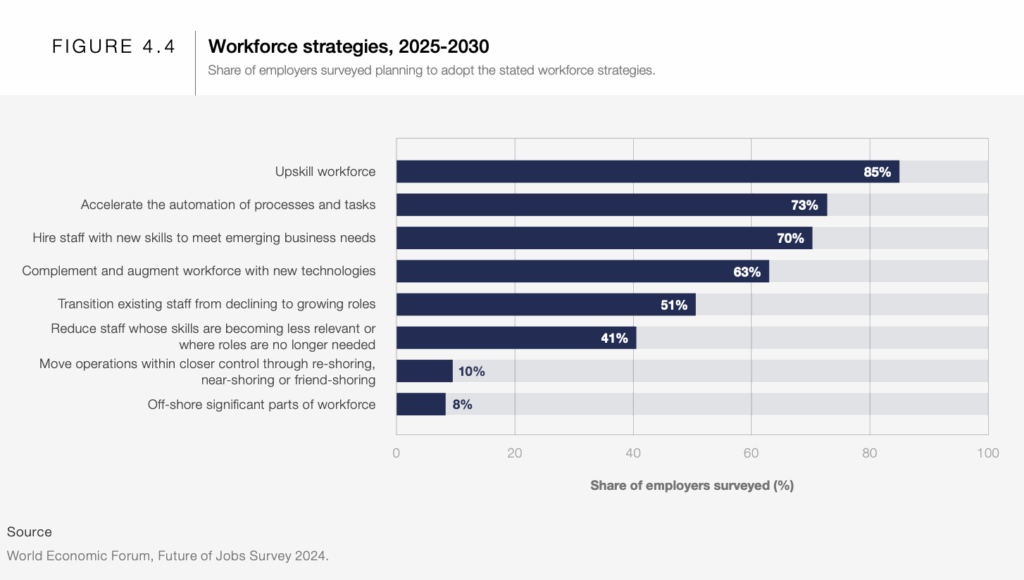
However, looking to the priorities for employers, upskilling the workforce, accelerating automation of repetitive tasks, and hiring staff for emerging needs, while also helping to upskill at the end, are the clear priorities.
My Thoughts: Enterprises will have to accelerate to bring automation to augment people rather than waiting to upskill them. It’s sort of upskilling while augmenting. This will introduce some level of automation. Enterprises will need to have in place effective core HRIS and Talent Management platforms to evaluate which gaps are the main ones to work on and how to tackle the prioritization of them, and close the gaps while also effectively hiring.
Conclusion combining WEF and Doomsday Clock: my reflection comes to the fact that all the innovation that has been mentioned at the WEF will need to be sustainable from a climate point of view, and AI will have to be properly governed to make it not influence the outcome, and the automation that will have to be introduced. Making people conscious of how much some enterprises care about regenerative economies, recycling, and accountability in upskilling or reskilling people, as the world will change, will lay the basis for a structured change, bringing proper evolution.
GG