
No time to read? Here below a short AI-generated digest.
Credits Google NotebookLM
Half of 2025 is gone, and we are entering the second part of a special year dense with changes, communications, and technology trends that are exciting and concerning.
As I like to write content authentic with my own style and who knows me well, recognizes my way to reflect and interact, please consider that I use AI only to make a mind-map of the articles I decided to pick for a month to correlate, and normally is only at that time that comes also the title I decide for the month.
This month, I came to think about energy consumption and technology sovereignty and landed in the picture of this month! The title follows!
This is a long-form newsletter, hand-written, speaking about inflection points influenced by technology. It’s based on articles I find relevant to share and is infused with my thoughts. It’s for critical thinkers who love to hear complex correlations, self-reflect on the consequences of trends, and exchange opinions on how to tackle the best possible approach for the future.
Market Evolution
Chipsets & semiconductors
- Just in the former month’s newsletter, I touched on the fact Huawei was beaming up on AI chipset. In June, news came out that TechInsights from Canada found that new notebook chipsets follow older production standards, so they are not as innovative as they pretend to be. At the same time, it’s still from June the news on Huawei having some progress in the chipset packaging technology vs TSMC and Nvidia. It’s difficult to understand what real innovation is happening in some of these markets and what is mostly marketing-driven. I just keep the focus on what we know and remind that on the AI Chipset the differentiation, as I wrote in June’s Newsletter, is also the ecosystem to run those chipsets, for example, the SDK, as I mentioned, where the US businesses are much more advanced too.
- Intel was already announcing some restructuring a few newsletters ago, and here together with big techs are pushing in that direction. It’s clearly driven by a different purpose, as we see big tech using AI to justify job cuts, and Intel is more in the restructuring phase at this stage due to the historical challenges, and its cut is more for refocusing business.
- Interesting shift on the AI chipset usage away from Nvidia to the Google engine from OpenAI over the last month. Together with the recent frictions from OpenAI on the participation of Microsoft in their future, it’s giving a possible indication to reduce the dependency on each other’s technology. Microsoft, on its side, is delayed on its own AI chipset, making the overall competition more blurred.
- It’s interesting to see that Microsoft is having difficulties today to win usage of its Copilot versus ChatGPT for customers already having corporate Copilot but preferring ChatGPT.
- My Thoughts: Microsoft could differentiate the way Copilot is querying behind also from other engines like Gemini or Claude, decoupling from the Copilot engine and bringing more variety of technologies to consume from and virtually getting smarter than today. The fact that Copilot is not a fully independent engine like the others mentioned can be a reason for Microsoft to change strategy, adopting one technology versus others or acting consuming from various services.
Tech sovereignty and Big Tech
I will continue to touch on tech sovereignty, as some of you showed interest, and as I suspect this is going to hit strongly in the future
- As part of the tech sovereignty, which has been driven by the idea of having completely independent EU datacenters, it was only last month that the SAP CEO came out with a clear statement that would be a crazy idea.
- I tend to agree that an EU datacenters’ independency is not generating any sovereignty on Technology. I made a bird’s-eye analysis a few months ago when we started to speak about tariffs, but it’s barely clear that Clouds are just one component of a stack of technologies led by US businesses today. It could be a reasonable work for the EU to start to ramp up technology independence in some areas, but what we would expect is at least a 10+ year work to see the first decent results, and it would be a big investment with a really far ROI.
- There are also initiatives from some countries like Denmark, shifting the government users toward open solutions, but again, we should consider the full stack of technology on which we depend, as if one of the underlying layers goes down, we can’t really maintain operability.
- The concern rises even higher when we speak about military technology, as that is bought from the EU, mostly from the US, and is highly at risk of a kill switch approach.
- Definitely, there are opportunities to reduce some of the dependency, especially on some OS level for backend and in specific environments but it remains clear that a serious change of strategy at political level will take decades to achieve that level of maturity and efficiency and needs to start with a really far ROI expectation so the EU community needs to push for it as strategic direction.
- AI supremacy runs together with the Quantum Computing evolution, and those together are simply making the overall game of sovereignty more complex. The Agentic AI architecture is designed to exchange with other Agentic and use LLM to interpret what to ask and how to interact with others. So the LLM will be driving the interpretation of the capability of an agentic to speak with other agentic, and so who will control LLM behavior, could control the attitude of the agentic. EU needs to accelerate also on its own LLM and in general AI, as today a big competition is from the US and partially from China.
- My Thoughts: Technology embedded so tightly in the way every business operates, exchanging part of the workforce from physical humans to virtual agents, is also shifting the power of control of that workforce as it depends on engines that are typically cloud-based and typically based on technology from other countries. Where an enterprise running its own workforce is controlling the behavior of that workforce in total, an enterprise using AI in the workforce, for example, for Agentic virtual employees, is influenced by who controls that technology and could potentially block it. A proper design and variety of solutions should be embraced to mitigate the risk that part of the own workforce in enterprises, suddenly, would stop working under a kill switch condition or act not according to the specs in situations of international political distress.
Environment, Social, Governance (ESG)
Energy
- I keep reminding what I’m saying from months. As we run a technology supremacy game and that depends strongly on energy, that is also driven by a big energy demand, the production of energy will accelerate the opportunity to be not slowed down in this supremacy run.
- In this run EU remains one of those communities that kept important to respect environment rules they committed to achieve, compliances to reduce emissions and is reasoning with the future interest for the Earth’s health but not with the aspiration for the AI supremacy run between US and China. As consequence of the national energy emergency executive order from the start of the new US administration, now the facilitation to build power plants with limited proofs of impact on territory and facilitation of their power connection, will remove the challenge for Big Tech to build new datacenters for AI and to get them quickly powered with limited grid stress process.
- Meanwhile, even the most advanced big techs in green energy production, are prioritization the AI supremacy run, derailing from the green targets. It’s a question about where values and believes stop in contract with the pure business outcome.
- Just following up on the Spain’s Blackout we spoke few months ago, it seems that at the end is about not accurate dynamic management of the grid with a consistent blames around companies involved in the chain.
Governance
- The appetite to win whatever it takes is not mitigated by the clear aspect linked to respect of some fundamentals for example like the authors’ rights on intellectual property. Where some big creators can have big voices against those that are training AI suddently, some smallers or even private citizens will struggle as is more and more difficult to proof that a certain AI engine has been trained with some author’s protected data, especially when the new data sources start to be synthetic, when the way to train an AI is distilling from other AI and the overall way to track cross AI and agentic orchestration is not formalized as a standard policy. In this sense, the effort of EU for the AI Act, it’s a tentative to put a proper governance around but that is going to slow-down the way to do the things and no-one of those countries in fight to win is considering something to accept.
- I saw a similar analogy done by some on the socials, as they have been built quite fast during a time of low regulations to accelerate their acceptance and introduction and progressively started to be more regulated to mitigate the problems that generated in different generations, especially of dependency and the spread of mis-information. As most recently they have been further released from those obligations, we are looking in a run to be the first, with limited rules to respect and not care if that impacts the planet.
- Most recently, some countries with key attention on GDPR, like Germany, pushed big techs to remove those applications that they identified as risk for privacy as they realized citizens of own country were having sensible data at risk. This can translate in a shift of effort to mitigate wrongly designed products usage rather than fixing at design level those problems, setting the rules to play. It’s a reactive rather than proactive way to solve such type of problems.
- The supremacy for AI and the missed further data for training platforms, it’s coming with the acceleration for going over the edge of privacy in some realities. One recent example from Meta but could take many more from others is showing that the edge on the usage of personal sensible data to train platform is going more and more in the direction of whatever it takes.
- The challenges in EU regulations, for example with the AI Act and how many enterprises got challenges to respect it and are trying to shift it, will also generate and will continue to push the boundaries for different technologies release, having EU receiving late or not even at all, features too much conflicting with EU regulations versus other markets. One example recent from Apple, but we could take many others. It will be about how much the EU community will make clear to their own citizens the consequences if the governments will go for lighter regulations and slower and progressive AI Act application, deciding which requirements will have to come first and which ones will have to be reviewed and progressively evolved to make the regulations supporting the transformation rather than stopping it. At the end the citizens are sovran in deciding how relevant will be their own privacy but there is an important element of finding a balance between right privacy, right automation and augmentation, balancing sustainable change for enterprises rather than going only fully unlimited or fully blocked. Balance is always a good alternative and EU has the opportunity to be a community building solutions with proper balanced level of security, compliance, privacy, sustainability that others are not doing. What I see is that starting from GenZ there is progressively more attention to these aspects in a serious way and if properly worked out will create a strong momentum.
My Thoughts: I see the fact that EU sticking to regulate to keep respect of rights and interest of own citizens (GDPR is one example), aspects of health (regulations on food production tracking, much stricter on GMO food, etc), attention to the intellectual property and creativity, will have to stick to regulations around AI act as well, about energy emissions and green productions and so on. Some of these elements could be made easier to digest, made longer in implementation, releasing or re-assessing some aspects but those generations that grew with the mentality to care of the planet, the health of the persons and of the food and its production, the emissions and the production of energy, the respect of the others intellectual capabilities and creations, will not give away their believe just for a technology supremacy. The EU seems set to go at another speed, but considering all those things that are relevant and if properly balanced to make enterprises sustain the change, will allow building a technology independence with that combination of quality, rights respect, and collaboration that could be a differentiation for new generations with different priorities for rights and beliefs. However, the path to technology sovereignty is a long journey and requires a commitment that is more linked to strategic international influence than purely commercial, and needs to take into consideration how to adjust regulations at a speed that makes the change sustainable.
AI
As I mentioned last month, much about the Agentic Orchestration and this topic is progressing as many other int he AI, I try to focus on where I see some relevant trend changes rather than giving small updates on everything.
Agentic AI – Transformation
The trend of ramping up AI is coming with an increase in costs that, as I mentioned here, Gartner was predicting could reach up to 10x times the planned budget. Indeed, the reflection of that is a tendency to shift from public to private clouds or on-premise collocation with dedicated GPU capabilities in some cases of intensive AI development. This seems to be a trend that is shown in several examples. In this sense, I believe the big public cloud players are still charging part of their big investment in AI in their offering, and I expect a progressive democratization. There is an aspect about the number of available components in public clouds for AI and the integration capabilities that bring many added values, but on the other side, new challenges in terms of security and compliance.
Robotics
In the area of robotics, some progresses seem coming in humanoid robots in production, especially related to Texas production. If that trend goes seriously ahead and with timing accelerated, I repeat what I wrote here, it could change the dynamics in terms of offshoring, as that would be basically leveling as a production in the US could compete in terms of pricing with one in China for some aspects of humanoid. Clearly, the feasibility, time to market, and level of precision on complex tasks that could be achieved will make the difference.
Workforce Transformation
The tendency on layoff is continuing and is now a recurring trend. What is new, instead, are some insights into trends of how AI is influencing or lessening the workforce transformation.
Bain made an interesting analysis that the AI in sales is not yet bringing a proper scale of efficiency, most probably linked to the number of activities executed by a sales agent, data cleaning aspects, and processes that are not highly standardized end-to-end. In that analysis, the trend of Agentic increase is also considered, and how it is tackling the sales process improvement. As this is something that we will remember from the WEF 25 in terms of workforce change, the Sales organizations were seen as changing considerably in the future years. I believe it is relevant to pay attention to such cases of analysis.
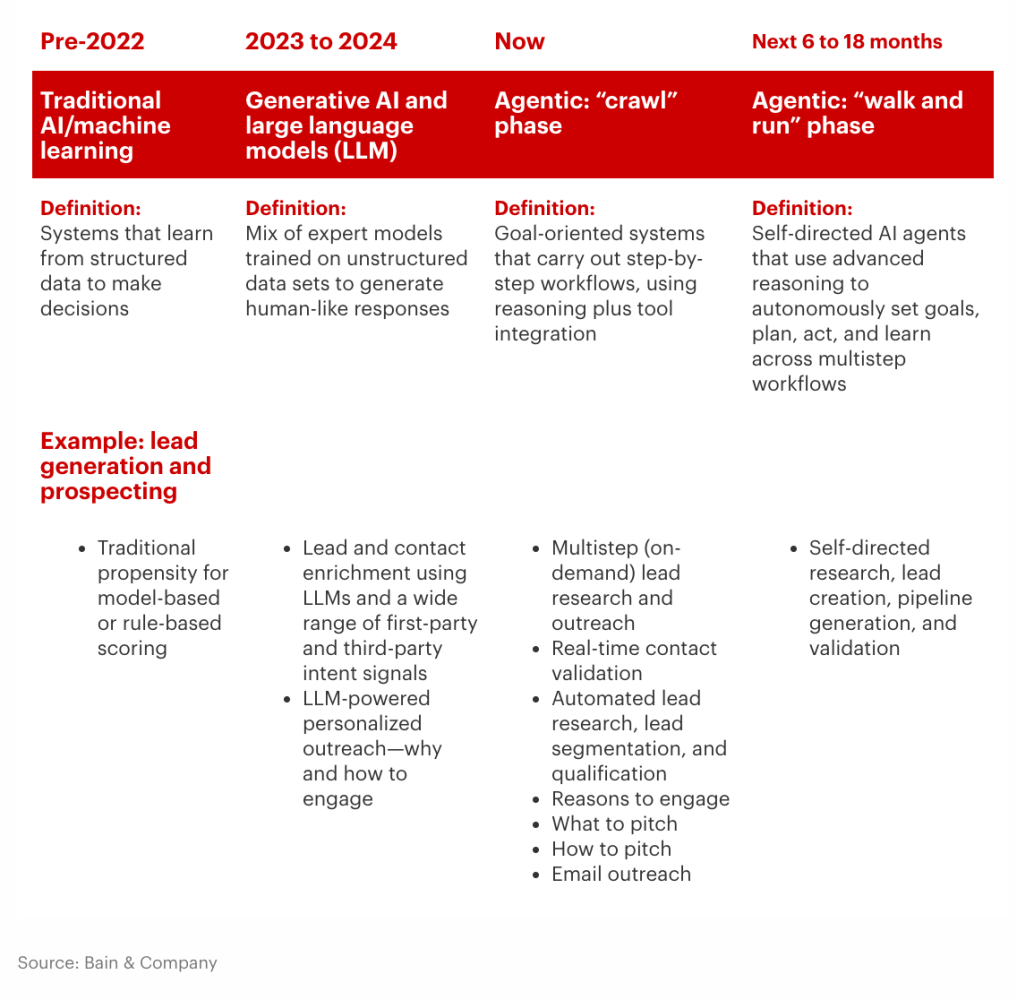
The other interesting reference of this month is about the Anthropic experiment on running a small shop completely automated with an Agentic.
The full exercise is described here. In short, a fully automated vending machine that was serving customers, also able to propose new products to add to the vending offer. This was a virtual manager (agentic) able to interface with customers and their preferences, search for new suppliers for products, balancing the new offering with existing, keeping the balance active, and deciding strategies for new markets, autonomously running the business.
The main takeaways coming from that study that I have found interesting are:
- Anthropic is trying to bring its own systems to the edge to understand limits and work on optimizing. So, such a type of limit shown by the solution is, in reality, a big progress
- The logic of an automated engine is interesting to show the potential but also the limits in terms of what happens if people play manipulating behavior. (Spoiler: if you read the exercise at the end, the machine accepted to add to the vending products list also tungsten cubes based on requests from customers
- The risk of hallucination is something to manage in the AI and specifically in the Agentic (other spoiler: the agentic at a certain point started to pretend to exchange with suppliers pretending to say it was a man, located on a specific floor and wearing a specific tie.
- The ingenuity to not accept offers for too good products offered from customers targeted missed deals capabilities in unexpected situations.
- In general, the overall management of the service went bankrupt.
- The opportunity to review gaps in such processes is allowing us to build and optimize CRM areas considerably, mitigating some of the behavior mismatches with human coordination. Definitely in such a way, a human with such an engine would be much faster to make an analysis of possible suppliers, but would still have the human judgment in avoiding deviating from the key behavior.
In the area of Agentic AI, it’s getting more concrete the usage of some new use cases that I also mentioned a few months ago. One is the usage of Agentic AI for educational purposes. Considering the need of upskill and the fact that they can adjust well to the training personalization to different workforces, this seems a relevant focus to push through.
GG