In the first two months of 2025, the number of trending news stories with relevant technology is increasing.
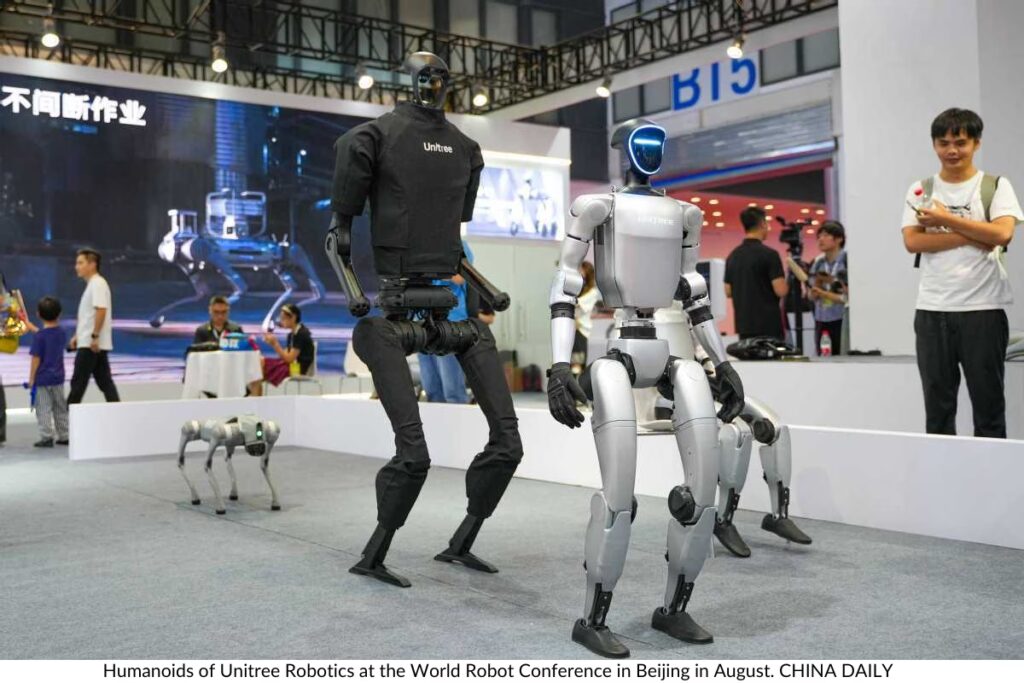
The picture of this month is from “Humanoids of Unitree Robotics at the World Robot Conference in Beijing in August. CHINA DAILY”
The key aspects I touch on in the title are the ones driving this newsletter, and specifically the humanoid robots, progressively extending with Agentic autonomous capabilities and AI capabilities extending at the edge through new chipsets and the acceleration of the Quantum Computing research and its potential disruption.
I also added a new section for Job Evolution (due to Technology) that is going to be a reflection and regular update based on the input coming from different sources, like the WEF 2025 Job Evolution Report and the way technology influences it.
This is a long-form newsletter, hand-written, speaking about inflection points influenced by technology. It’s based on articles I find relevant to share and is infused with my thoughts. It’s for critical thinkers who love to hear complex correlations, self-reflect on the consequences of trends, and exchange opinions on how to tackle the best possible approach for the future.
Market Evolution
From the chipset competition:
- Intel is still in an unclear state if they are going to be bought or develop, but a few things are more clear.
- So what? I just guessed last month here, literally “US Administration to push hard for revamping the Intel production of semi-conductors in the US, embedded in the Qualcomm production and reduce their dependency on TSMC.” Now, what we just saw announced here from JD Vance is making clear that “To safeguard America’s advantage, the Trump administration will ensure that the most powerful AI systems are built in the US with American-designed and manufactured chips.”. What I can speculate from this, as many investors, is that Intel is on the path to be most probably bought, and one of the possibilities is indeed Qualcomm, as well as foundry with TSMC.
- My Thoughts: I think that TSMC will anyway produce 2nm semiconductors in the US this year, so I would expect that a part of Intel could go to TSMC, a part to Qualcomm, but I would consider also AMD part of the game that would otherwise remain too much behind.
- So what? I mentioned here in early October that Qualcomm would win against ARM due to many reasons I explained in that newsletter. Here, the results that happened in February confirm that ARM gave up.
- In the competition for AI chipsets, OpenAI is also entering with its own design, competing with Nvidia and collaborating on the implementation with TSMC and Broadcom.
- The Stargate roadmap for 2025 is already considering 100B$ planned and a few AI Datacenters to be built in the US by September 2025, and will run mostly OpenAI and Oracle.
- My Thoughts: I expect that Oracle will beam up in the stock market and that most probably the Deepseek will allow democratization of AI, as I wrote also in last month’s newsletter in more detail.
- Reminder on the AI Chipset export restriction from the former US Administration to go live within 120 days by the release (Mid January 2025). I spoke on it in my former month’s newsletter. So far, I saw no news on this, but I expect it will create some friction that will be somehow also a reason to accelerate the alternatives like CXMT in a freer market.
- Qualcomm to make a chipset for cheap phones much more performing. This will reduce the gap of CPU-intensive activities, like game playing on cheap phones, that until now have moved a certain generation toward high-end devices.
- My Thoughts: High-end devices will need to find new ways to justify their premium cost add or will risk being less often selected, especially from those new generations using for gaming that would be able to replace phones as performance lacks for a fraction of the cost.
Looking more at the crypto news:
- So what?: It seems that some cryptos are up and down (like XRP), and I predicted strange behavior last month here. By the way, my speculation on the fact that Solana would continue to rise due to meme development was wrong because not consider the fact that the meme market got shocked due to a reduction of interest. The reduction of interest is the confirmation of my concerns about investing in useless memes that I said here and most recently here. Also, recently, the $TRUMP meme had a further impact on 800K people who invested simply too late. Recently, Elon also changed his name for some hours on X with the name of a meme that skyrocketed for some hours and then fell again, leaving many people with just lost money. I report all this to warn against meme coins that, for me, remain simply like investing money in lottery tickets, where only a few wins, including who own the ticket generation process.
Environment, Social, Governance (ESG)
In the Energy world is valid to mention:
- On nuclear fusion energy, after January, China recorded 1000 seconds, breaking the former 400-second record of 2023. In February, French CEA West achieved a new record of 1320 seconds, or equivalent to 22 minutes. The curve of acceleration seems consistent and starting to promise interesting improvement in the distant future, which may not be too long.
Under the aspect of Social, after the recent US tendency to the cancellation of DEI Practices:
- Some companies like Apple have kept their focus and support on DEI so far and are giving a certain stability in their organization. However, they recently showed some openness on the privacy aspects that were always a key reference of their brand.
- Google announced their end of ban for AI weapons. Why is this important for me? Because Google employees were in the past highly influencing the strategic decision for Google to enter or not in some businesses, and this was one area that in the past they strongly voted against ( Does anyone remember the JEDI Project?), and could influence the type of resources that could leave in the future.
AI
Most relevant updates in the general AI development:
- Google last month at the AI summit in France reported that over 18 months, they saw a reduction in the AI cost by around 97%. This is going to be even further accelerating from my perspective as the AI cost will be further more cost-effective, especially now with the progresses done, for example, from Deepseek. I keep saying what I predicted last month, that we will see further democratization of the usage of AI across the world, as the cost per operation will get cheaper.
- Costs Optimization: I would highly recommend holding a long-term commitment to big clouds, based on LLM and other AI computations, unless granting lowering adjustment of per unit price during the agreement, as I see this pricing lowering heavily in the next few years.
- Some interesting uses of AI have recently come from the biological world. In February, EVO-2, a biological open-source oriented AI engine to analyze correlations between genes (also quite far apart in the DNA sequencing), and also detecting if some sequences would already be somehow existing in some other segments in correlation with specific mutations causing specific diseases. This is a usage of AI allowing to really progress in a short time in detecting and possibly solving diseases that normally would take ages to be analyzed and optimized.
- Most recently, the start of the Deepseek approach, including LLM distillation and some of the most recent work around training AI with AI, is showing that it will be less and less expensive to train AI engines. In parallel, there are today already a decent number of LLM engines designed to run on lower resources machines and the development that are happening in the AI, to build up chipsets with stronger AI capabilities, it’s progressively introducing the capability to tun AI at the edge, so near where they need to be consumed, reducing latency and making also mission critical applications realistic. This is going to open a tremendous opportunity, touching all the environments like cars and other equipment that are basically distributed and moving the calculation back near where is needed, and clouds remain with the focus on bigger data and process computation. Considering the updates I gave on the Market Evolution section about new chipsets also from China with more and more AI capabilities, the acceleration of this market is happening and is bringing many consequences in the accessibility of AI that will be more omnipresent and cheaper to consume.
In robotics, some interesting updates:
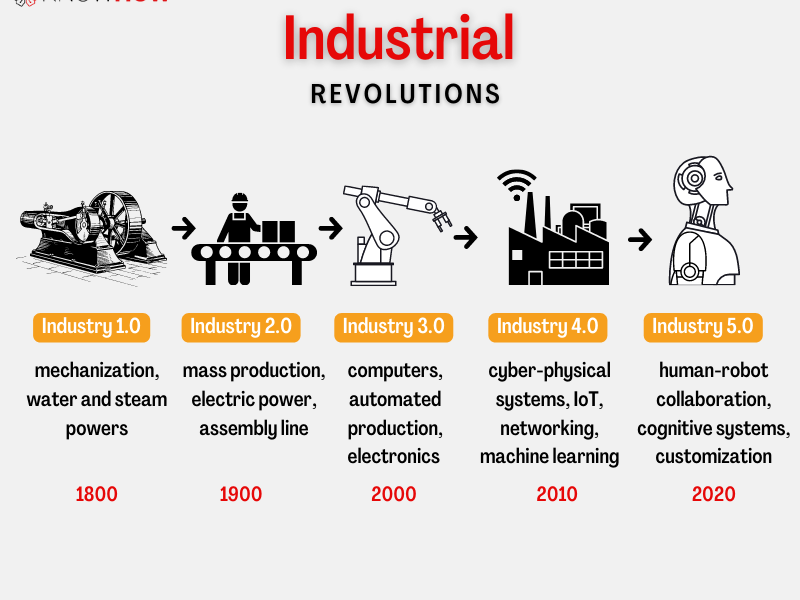
- There is a proliferation of human-like robot developments with a short timeline to market from different vendors (from China, Europe, US). It seems that the trend is going to accelerate, and the aim is to assist in home daily tasks and industrial activities, accelerating the concept of Industry 5.0 (image below)
- For example, the Norvay Neo X1, Meta’s most recent announcement, Chinese PM01 are all examples of humanoid robots with a purpose for home assistance. This trend could be relevant and has a parallel in manufacturing with heavier robots partially already in place and now getting more integrated. Also, Tesla has important updates for next year with their humanoid with an industrial focus.
- Recent developments in the agents are further scaling on multi-modality, which is key to the capability to interact on different dimensions.
- The edge AI is getting more concrete as more powerful chipsets are developed. This is definitely relevant in the industrial IoT, but it also has many applications in the consumer market.
- My Thoughts: Here, my speculation is based on some of the previous months. I see the converge of humanoids robots grow (that could be even not humanoid liking to make people less concerns), evolution in the market of agentic to make autonomous decisions and on multi-modal ways so interacting on chat, vocal, images, physical and edge AI (I just spoke earlier in this section) to be able to make AI computation at the edge and to compensate of cloud latency for high volume, realtime elaborations and missed connectivity. As all these technologies are now more and more mature, the future equipment could be really autonomous, fast deciding without relying on delays due to cloud latency, and also having enough physical flexibility to assist in various activities and learn as they go. The number of applications in industries, home and customer activities would be quite immense. As I analyze more in the main job market evolution section, the demands for some repetitive activities by different industries could accelerate the adoption of this modernized equipment.
In the AI regulations:
- One aspect I like to refer to is the AI Act, which is indeed an EU regulation that is highly debated, especially from those US big tech companies that want to develop with limited restrictions to be faster. The concern I see here is about aspects of privacy, as first, quality of data and training sources, especially if we start to have LLMs trained through distilled data from other LLMs, where the source of content and its quality get really hard to maintain. Someone made the association with when social networks accelerated their introduction on the market and gained limited regulations and as consequences influenced poorly the privacy of people and caused several side effects. I think a way forward on AI governance will need to find a compromise way that can’t be fully open and can’t be fully blocked, but needs to happen now, not in 5 years.
- My Thoughts: The data we have today in some trained platforms could be violating copyrights, as in many recent conversations happened and could have bias based on how they have been trained. Agents running on top of them could have quality problems in answering according to the proper boundaries set, and based on the source of training.
- The energy consumption of AI is also part of the debate and will be relevant even if mitigated by the innovation coming from the most recent discoveries.
- My Thoughts: Some companies could decide to self-regulate to grant a proper conscious way to consume AI products, and that could raise the standards and expectations toward the big tech suppliers of those technologies. In some cases, we would have augmentation, where the employees use AI to enhance themselves but would still be accountable for decisions, but there are many use cases of full automation that would put autonomous AI agents in total responsibility of answers and decisions. A company would link its credibility not only to its employees but to its AI governance. Imagine a company with a fully automated AI customer service that would give impolite, wrong answers or even harmful answers to customers. The reputation of the company, not of the AI, would be quickly impacted. This is one out of 1000 examples I could quickly imagine.
Quantum Computing
Relevant changes in Quantum Computing:
- As you may remember, in my January Newsletter (referring to news of December 24) I spoke about the acceleration of Quantum Computing provided by Google Willow and its modular approach. In this March Newsletter, I report the update, only two months later, from Microsoft with its Majorana new quantum chipset. Interestingly, both players take a different approach to the same target to achieve the quantum computing predominance. Google approached the errors from noise of qubit interference with an error reduction approach (you can find in my former newsletter, which I referred to before). The approach is different, and building new materials to be able to create new states and build a qubit that would not interfere with them. The aim for both big tech is to achieve the supremacy of 1 million qubits. This level of supremacy would also be able to crack most of the actual algorithms, not PQC (Post Quantum Cryptography) compliant, and there is a progressive belief that this is happening in the next 5 years, not 20 years.
- I have found a recent development in the area of distributing qubits across wide networks. This is still at a study level, but potentially, I see it could help to build up much more distributed quantum computing if it were able to guarantee the distribution of quantum information with a low rate of error in transmission of information.
- Also, Amazon comes out with its quantum chipset, Ocelot, in competition with Microsoft and Google.
- Another interesting study, still on an early simulation level but going in one direction I see relevant (AI and Quantum computing, or better specifically Machine Learning and Quantum Computing), is about this work that is working on building an LLM on top of quantum computing. The potential benefits are linked to the capability of problem solving and addressing at the quantum level of computation.
- All the acceleration that is happening in quantum computing can be seen as a threat to big AI Chipset players like Nvidia, and explaining why its CEO Jensen Huang was trying to push the quantum capabilities as a far solution in 20 years, even if the facts are saying something different and much faster.
Job Evolution
Last month, I started to look at how the World Economic Forum analyzed the future of the job market here.
From my first analysis that you can find in the link above, there is a clear shift in the job market in the next 5 years, with a big component of automation that is playing a key factor, a strong level of up-skilling resources, and many millions of jobs created and in part displaced.
Avoiding repeating concepts and first opinions already shared in the former newsletter, I want to take only a few takeaways relevant to the new skills required in the future and start from there to analyze a few other aspects of the WEF 2025 Future Jobs Market Report.
From Figure 3.6 in the report, it is visible that the main skills identified as needed in the next 5 years are some skills that went out of scope.
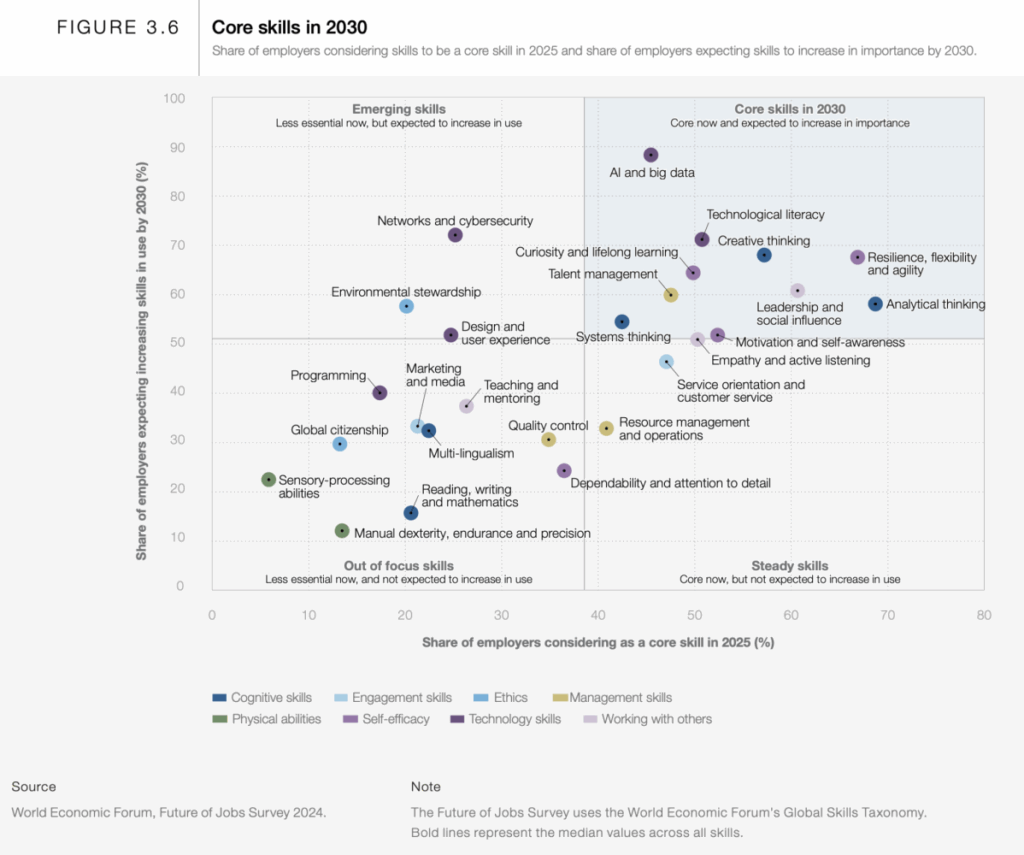
Reading the documentation carefully, some skills out of focus, like Manual dexterity, are considered still existing for really complex manual jobs, but the effort to build them is much higher than gaining, for example, technological literacy, and for this reason, in many jobs, the focus of the demand will shift. The AI will also make many of those skills marked as out of focus less relevant. You can find, for example, programming, as the AI is doing a certain level of it, but it is going to be a required skill, for example, systems thinking, that is normally allowing to evaluate better the quality of the output of an AI to be used. I still debate that reading, writing, and mathematics for me will be relevant, but most probably the view of the interviewed people is that AI will compensate for the skill gaps of the people with limited knowledge, but I doubt having strong analytics skills without having developed former reading and writing skills.
I focused the exercise for this month, looking at the view of industries and how the activities get automated. Before passing on this, let me give a few definitions. An activity is defined as manual if mainly done by a person. It’s considered automated if it is done completely by a machine; it’s considered augmented if it is done by a person with an AI integrated somehow.
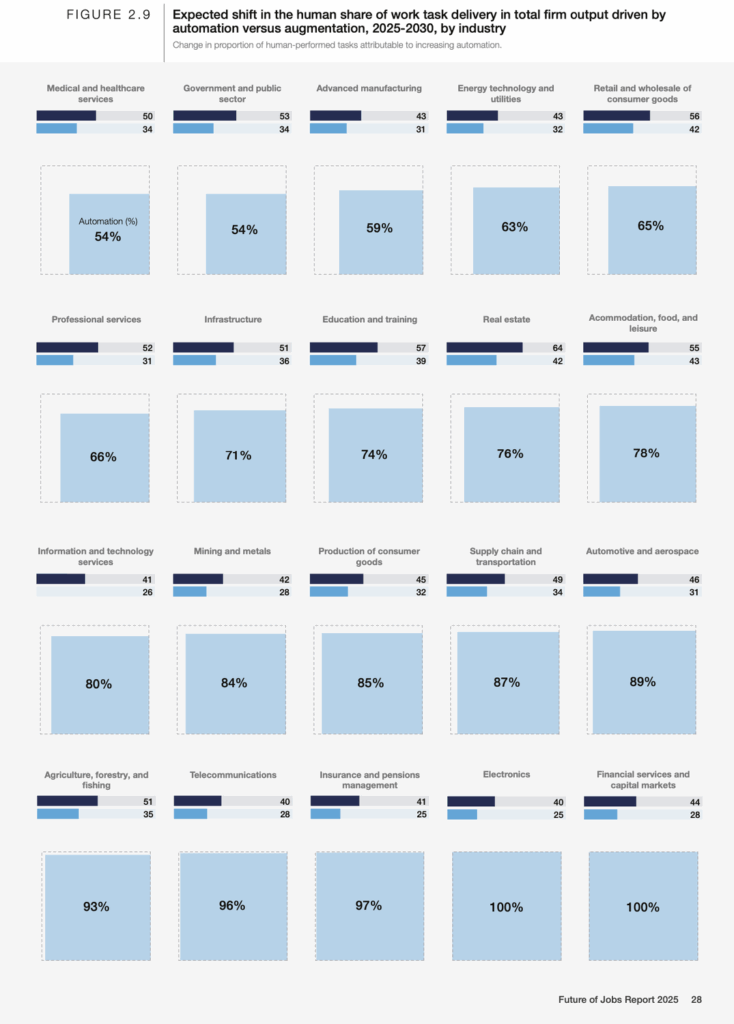
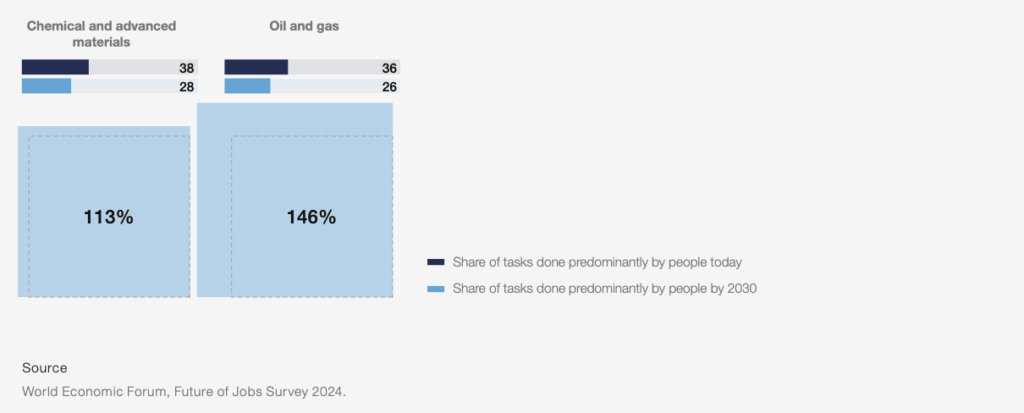
Different industries react with different percentages of automation, but what is visible is that for every industry, a certain number of tasks are being done manually (the ones marked in blue as done by persons predominantly) is reducing, in some cases less, due to the fact are most probably highly complex and specific, in some cases more.
For all the tasks that are not considered predominantly done by people, which represent 60 to 70% of tasks in 2030, a big portion is predicted to be fully automated, meaning done by agentic systems without any human interaction, and a part of it, the white part of each of the squares, is the augmented part. So, for example, Pharma expects to have from half of the tasks predominantly done by people to 34 out of 100, and for the remaining 66 tasks, 55% of them would be automated (so no human work), and 44% would be done by humans with augmented AI.
Looking at this summary, you can understand that some businesses reach a high level of automation, and in some cases, the automation is showing even more than 100%, meaning that it is eating activities done by the augmented people with AI.
This is telling us that people would get less busy with repetitive tasks and would focus more on the high-value activities, so most probably fewer tasks but more intense in complexity and value added.
This is also telling us that in the next 5 years, companies will have different activities, and below, a repetition from last month, I attach the key priorities.
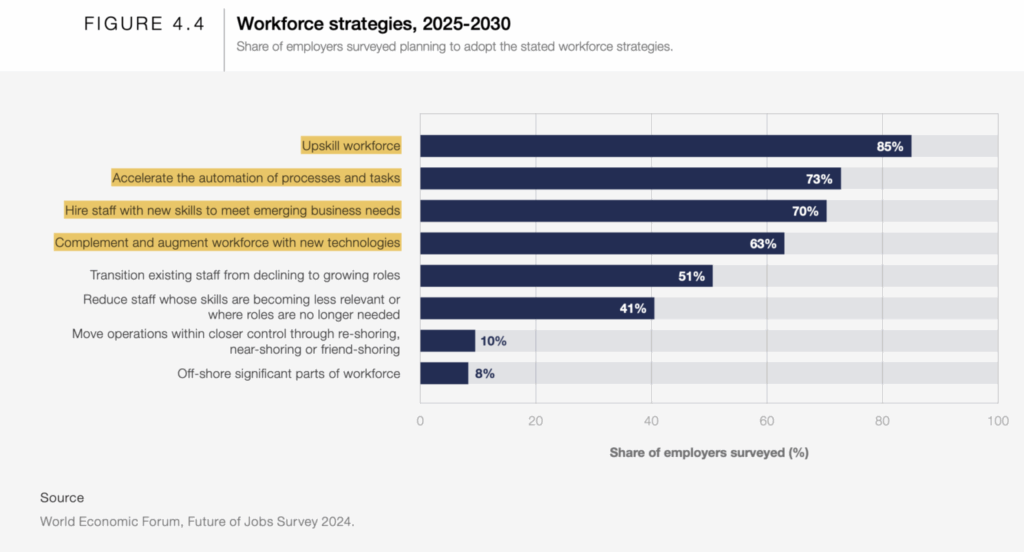
As is clear, the companies will have to focus on up-skilling resources, automating, and hiring people who would help to do those activities to match emerging businesses and to enhance the competence to use new technologies.
I try in the newsletter not to make too deep an analysis, for which I prefer to build dedicated articles or conversations, but I aim to stimulate the reflection as an update to keep in consideration. Below few possible aspects to keep in consideration.
Revenue Opportunity: The automation of many activities in the back office can accelerate the overall customer feedback process for products or services dramatically, reducing the time to market for innovation and the anticipation of customers’ needs
Costs Optimization/Ops Excellence: The introduction of a proper, unique HRIS engine allows for keeping a proper track of the workforce effectively, especially during a strategic up-skilling process, identifying, classifying, and developing core future skills. The optimization of workforce usage and allocation of resources can deliver savings in licensing and product allocation to the workforce, as there is a better focus on what to invest in as future needs.
Risk Avoidance: Setting a proper governance around which processes to automate first, and following which criteria (not critical tasks, proper 4-eyes with humans, proper PoC, quality of training engine, etc.) can mitigate risks of reputation that could have a high impact.
GG