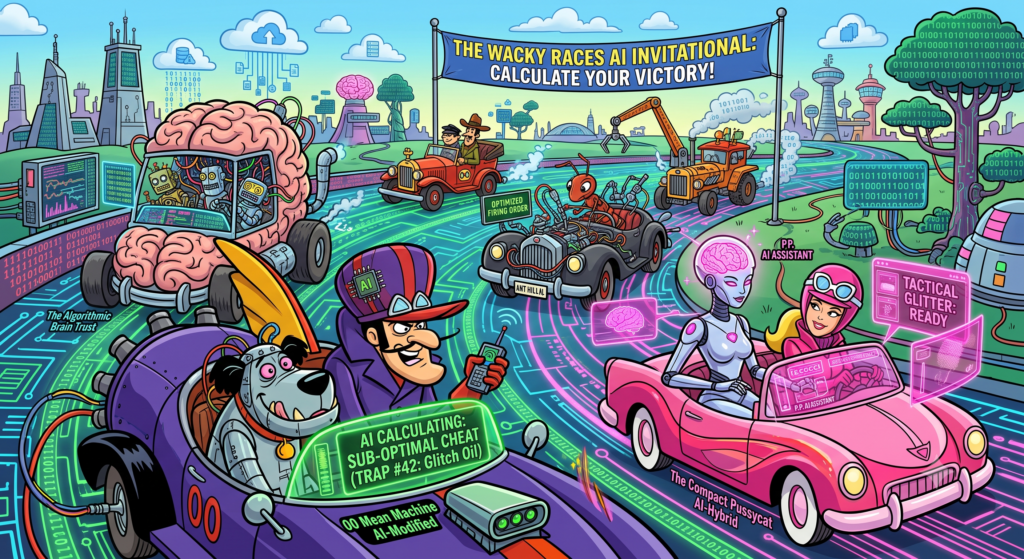
This time I decided to focus on the actual status of the run between countries for the AI lead and, at the same time, the increasing investments from many actors to reduce dependency on foreign countries, with a focus on supporting digital sovereignty. All this is happening fast: requesting funding and pushing for workforce layoffs in search of liquidity and cost control.
All this looks to me like the Hanna & Barbera cartoon Wacky Races, on which this image is based, in which at each episode the different players were finding a way to win, creating some traps for the others. Image generated with Gemini Banana.
This overall race is running while the world is heating, with Europe reaching its highest temperature in a while, an increase in data centers requiring more energy and more water to cool, energy production from fossils and especially nuclear, reduced by over 20% due to the high water temperature, influencing the overall efficiency.
My reflection also takes into consideration the fact that building resources for AI while caring for digital sovereignty is demanding extra redundancy, putting global sources of energy, water and key materials under pressure and stressing further the supply chain, especially for strategic goods.
I started this newsletter around 2 years ago, during a hot August, also from a technology point of view, when a major release error from CrowdStrike brought part of the world to a freeze on several digital-driven activities for days across many countries, showing the fragility of the infrastructure we are using. At that time, you can look in my first newsletter here, even hospitals and other core services were limited in operations.
That was a time when automation was not yet embedding full autonomous AI agents as we trend toward nowadays, and nevertheless, the way this impacted business was very fast and relevant.
In the meantime, the world is on one side getting more integrated and bringing autonomous actions. AI is more involved in many supporting autonomous decisions, sometimes passing to core actions (like in Cyber and military). We are embedding more automation in our operations, with relevant impacts like the ones I mentioned in the past months.
The world is also progressively segregating across regions, with capabilities split due to an increased need for digital sovereignty but also a different level of digital maturity and technology capability, creating a gap in some areas of the world. The work of some countries over the last few years, raising bans across the world, accelerated the seek for independency much faster than I would expect and we see today EU and China working hard to get more independent on some digital layers, even if there is a complex dependency stack that I mentioned in the past newsletters for example recently here and more than one year ago already here, that is still existing and will take time to be fully removed. Europe especially is also strictly regulated around ESG and key founding principles, impacting their speed to find alternative ways to react.
As usual, you are more than welcome to comment on LinkedIn or Substack.
Quick Executive Takeaways
Key technology priorities to focus on for your business at this stage, if not already done:
- Transition toward AI Global Business Services & BPO: Reassess outsourcing contracts against AI agent capabilities. Consider an insourcing strategy for well-described processes where agentic automation reduces dependency on external providers
- ERP: Start to execute on IT/OT integration within a modern agentic approach and composable architecture
- AI: AI Governance, link AI initiatives to 2-3 business domains rather than spot use cases, differentiate strictly between initiatives for AI augmentation, AI automation, and reimagined processes with AI. Design a stack for multi-AI composition.
- Multi-cloud: strategy update with repatriation and sovereignty considerations
- HR: up-skilling the entire workforce on AI-driven training platforms
- Cybersecurity: Initiate roadmap on Post Quantum Cryptography (PQC)
If you’d like to understand more about what is behind these recommendations, feel free to dive into the different sections of this and previous newsletters, or reach me for a further conversation about your current challenges.
Market Evolution (Chipsets, Big Techs, AI)
Chipsets & semiconductors
Going 3D, fast versus Angstrom, slow from shortage!
This July saw an acceleration in Nvidia and other AI chipset manufacturers in stock market value, driven by an acceleration in demand for the AI chipsets, as explained in former newsletters, being a big part of the revenues but representing only a small fraction of the overall chipset production.
This overall focus impacted many parts’ availability, memories shortage as first, and the overall supply chain has diverged between big players securing hardware for next-generation products and those that remained behind. The smartphone market is a big example of this.
IBM progressed to 0.7 nm for chipsets, influencing a few elements that have already been relevant for months, with a considerable increase in performance and, at the same time, a reduction in energy consumption of up to 70%, doubling density versus 2nm nodes. This approach is far faster than competitors at 2nm and now 1.4nm but is approaching 3D layouts, having some higher costs to produce, making cooling more complex and adding complexity and cost that could justify only for high-end parts.
Huawei, limited by the US Administration to access the most advanced lithography from ASML, progressed toward 3D layouts as an alternative with their LogifFolding approach, expecting by 2031 to be able to produce below 2nm, competing with TSMC.
Too little, too late
The US administration imposed a ban in the past to stop the export of Nvidia’s most advanced chipsets, as I analyzed in former newsletters. You can see there how that started a long time ago, evolved in different directions like TSMC’s push toward Arizona, several restrictions also with Nvidia and others, and accelerated over the entire last couple of years. I was predicting, for example, in June 2025, that China would progressively accelerate its own developments with Huawei and others, around its independence. I analyzed over the year the stop-and-go in the approval of access to some of the older AI chipsets that simply accelerated the need from China to follow its own path. The recent change of direction from the US Administration, taking away the 25% ban fee for the chipsets sold to China, didn’t bring the expected interest from the China market anymore. It came too late, and meanwhile China organized to be less dependent on US technology and accelerated in several directions, as Huawei did.
The rise of Edge AI
The recent development of Nvidia’s RTX Spark, in the segment of stronger AI chipsets for the client markets, including Windows PC, empowering AI reasoning on devices, is a relevant change toward a stronger offline capability and edge computation that can extend outside big cloud datacenters.
I often mentioned how relevant the acceleration of edge computing is to allow computing power for low-latency devices, like physical AI with robots and OT equipment, but also in general to reduce the token charge for those computations that don’t require a full online LLM but could run on-premises technology. The recent announcement from Nvidia and Microsoft on the new workplace chipsets is sending a message around the acceleration of AI capabilities in the workplace and, as a consequence, on the overall edge technologies. This is overall increasing the AI reasoning at the edge level that would address a challenge that I mentioned some time ago here.
My Thoughts: In the case of IBM, I’m curious if such a complex layout would be directed toward the development of IBM’s quantum computing chipsets rather than limited to high-end AI chipsets. The development of Huawei is simply part of China’s agenda to reach full technology stack independence. However, the acceleration of AI chipsets for edge computation, even if in the consumer market, could progressively make it harder to enforce consistent export controls. Stronger AI reasoning on devices, it will push for Physical AI evolution, OT, and will allow companies to start to design more seriously around containing AI bills, deciding to be more systemic on LLMs on edge computation and optimization of token usage.
Big Techs
Google and Microsoft paradigm shift? Better late than never!
In September 2025, here, I was doubting the new service from Google related to AI Overview in the existing business model, driven by the fact that fewer people would search directly on the source links and, even more, agents AI would drive the searches directly. In the same newsletter, I also questioned the approach of Microsoft not building its own LLM and reaching a situation of dependency on a single vendor (OpenAI) with limited flexibility.
As the facts shown, recently analyzed here, Google reached 68% of searches with 0 clicks, meaning that those searches didn’t dig into the associated sources summarized, impacting Google’s historical revenue model based on advertising. At the same time, Microsoft realized that their internal cost to use AI from third parties, especially in coding, is hitting their revenue, and they are now accelerating their internal LLM progress, already available for some time and named MAI.
Google got challenged on this changing business model from providing ranked links for searches to already summarizing concepts to end users in the AI overviews. As the answers are AI-built, with some probability of error, that generated attention, for example from the German Court, on defining the liability of Google for the output delivered in the AI overview. That is considerable because it is shifting from users to Google the responsibility for the content summarized, following the EU Digital Services Act for media content providers. Even more, some companies can play the so called “sloptimized” approach to manipulate how results get digested by AI Agents and proposed in summaries from different LLMs.
Microsoft built its own model with a layer, Copilot, on top to decouple from the specific LLM, so could potentially benefit to use own MAI models to provide to clients, but the proof of its value and precision is still to be recognized by the market and can be a threat to their own development. Too easy a joke for an Italian, as we are used to saying: “Meglio tardi che MAI”, meaning “better late than never!”
The tokenmaxxing challenge. When the business case with AI gets difficult to justify
In December 2024, I mentioned here, how many researchers were raising attention on the potential cost of AI and how it would potentially ruin budgets with 10x versus initial estimations. Already in October 2024 and later during 2025, I was often referring to the attention around the risk that AI would overcharge versus the benefits. I even have marked that in the attention on the Key Executive Takeaways as a clear focus point linked to two major root causes: the increase of engine capabilities, consuming more tokens, and the unpredictability of part of the results, requiring redundant computations to reduce risk. On one side, I always thought AI would reduce its cost per token, but so far we are still seeing a strong development of new capabilities and long-term investments that are getting more and more charged back to the consumers. In this sense, the cost per token goes down, but meanwhile the new models are consuming far more tokens for their inferences than in the past, and key differentiation comes from selecting the right model for the right level of answer. This is one relevant challenge, as often some of the automations on the market are driven by business cases that can get less interesting if the AI they depend on can ramp up costs to execute activities.
As we saw with Uber and Microsoft, explained here, they have been impacted by their usage of AI tokens. Uber consumed the entire yearly AI budget in their token usage plan after a few months, and Microsoft gave a strong cut to the internal usage of coding AI tools (like Claude Code) due to the explosion of costs and most probably also to push its own organization toward internally developed tools. This was the case also recently spotted by Gartner, after the recent new SAP Sapphire announcements for some AI services not fully priced at the time of the event.
The more we run toward automation, the more AI agents are burning tokens to deliver results. Approaching the AI transformation rightly is key. In my Thoughts below, some considerations on how to tackle such challenges.
The challenge of consulting in AI
It’s news of recent months that Accenture got a 18% sink of their stock value influenced by big investments in OT security they have planned, not compensated by the same level of increase of investments from clients where AI grew as a component, but other parts of the IT budget reduced. A component of it is also influenced by the question of how much integration costs will reduce thanks to AI, making those integrators have a harder time justifying big integration fees.
My Thoughts: Different reflections here. First on Microsoft. Their paradigm shift is driven by the wish to push internal organization to use their own tools like Copilot CLI and supporting the internal development of their own LLM, as mentioned earlier, but is also giving a signal of how the increase of complexity in tasks with proxity with human complex activities is consuming a much larger amount of tokens. Microsoft, in this sense, realized the impact of depending on foreign models while others like Google played strongly to develop their own chipsets and models, as I mentioned in former newsletters, reducing cost per token and shifting to internal ownership of models. The strong enterprise integration and compliance can be still differentiations to push Microsoft to renew its strength in the upcoming months, but it is an opportunity that can’t be lost anymore. In this sense, the Nvidia and Microsoft agreement on the AI chipsets is a special opportunity for Microsoft. This technology jump in the consumer market could gain value to accelerate real on-device AI calculations, potentially redesigning edge AI in enterprise, also in OT, but it requires a proper ecosystem redesign around it.
The AI chipsets for a wider market are an opportunity to expand also on edge AI in OT and accelerate from robotics to real Physical AI, reducing latency and achieving real-time, reliable decisions on device, including new device types like smart glasses. However, opening to a wider market on devices with AI is also making any country ban in the long term more difficult to keep, especially when this addresses such a wide market like the consumer one.
It remains not clear to me how fast Google can shift its own paradigm from strong advertising-based revenues to a service-charged model like OpenAI or Anthropic are doing. Google started to make clearer the cost of their Gemini product, showing more actively the user consumption of tokens and the limits, and at the recent Google I/O, they explained the shift toward Compute-Used model-based and building an entire framework to use AI, shifting their focus more on the service business. This is the effect of a long-term strategy, started with accelerating data centers for clients trying to catch Azure and AWS and introducing more capabilities that could be connected to their core services. This is a shift away from historical applications to create more of a baseline for future applications highly depending on their core AI components.
This type of paradigm shift is requiring time and is forcing a movement from a strong monetization based on advertising and SEO to an AI framework consumed by agents and highly GEO-driven. People are today buying OpenAI or Anthropic as vertical products in a specific new segment where search is just one of the components but is no longer enough. In this context, Microsoft plays strongly in the enterprise focus, having lost their initial bet on Bing but needs to prove the value add from their AI integration in the enterprise context. Google historically is seen as free for usage from the end-user market for search, and the change of paradigm takes time to evolve in a service business, also for those markets historically based on advertising. The value to profile users is no longer based on their searches and interests but on a deeper understanding of all their usage of services, complete context across dimensions; it’s going to be a key differentiation for future user profiling. Who is going to have that level of overview is still a battle to come.
Regarding the overall AI budget topic and its estimation toward agents’ costs explosion with automation, the effort in the near future is to properly, granularly decide what to position in one or the other model, split across the proper level of verticalized agents, and orchestrate with the right level of context awareness to gain enough precision in answers without too much noise and keeping token consumption under control. The market is still in strong evolution, so positioning on one single vendor lock and pretending to be safe for the next many years is risky because over the last two years we have seen a strong shift of power in AI big tech leaders. Making business cases without making a proper estimation of future trends can simply make the overall operating model of your own company too expensive to run, automating at a cost higher than before. Every company, as for example McKinsey has analyzed in the past, has to make the steps from use cases with AI to gain a few business domains to optimize end-to-end with AI to gain real P/L impact. Here is where the overall cost to run the AI makes sense to be analyzed because the more integrated business domain with AI has boundaries of cost different than the single isolated use cases and can help to define a more realistic overall spending for AI by domain and reflect in the value creation in that specific context.
Digital Sovereignty
Data is the new gold and can be stolen too!
Connected to what I wrote just as my Thoughts in the former section, it looks clear that the data linked to profiles of users and enterprises is getting far more relevant to monetize in the long term. Better profiling is giving a 360-degree perspective of people and companies. Some countries started to realize the risk of this general overview and how AI can accelerate to correlate data from different sources and build a multi-dimensional matrix of correlation. In recent months, Palantir, a big player in data correlation with AI, which entered strongly also in many EU countries during COVID, giving benefits from correlating people’s data to better manage the sanitary emergency, started to get some restrictions back from some governments, as happened recently in Germany and France, in favor of EU-based solutions. In this sense, AI and the overall relevance of privacy data, strong in the EU, is a driving force to accelerate the EU market in this sense. Interestingly, this driving force for this change started from counter-espionage, and France is developing strongly as a country with strong AI development compliant with EU regulations.
People sovereignty – The Pokémon Go case
An interesting case that came more clearly to light months ago was the one of the usage of data collected from the game Pokémon Go. When I read the news, reposted here for example, saying that basically the pictures captured during the Pokémon Go game years ago were used to train drones for war purposes, that made me reflect on how many people were not aware of having participated in training autonomous drone war machines. It’s clearly a gray zone in terms of how someone could opt out and request to delete their own data, as sharing was accepted as game participation. But the reusage of data for training AI is a big topic that is big and is going to extend even further with the copyright infringements from many AI players using protected material to train their engines, even destroying millions of books for achieving this purpose.
Anthropic ban
In the last few months, Anthropic released a new model more advanced and then quickly got blocked by the US Administration, executing a ban for foreign citizens to access the new AI models. This case came after a few months of restricted access to selected US companies for Anthropic’s new models due to cybersecurity threat risks, as I analyzed in depth in the former April Newsletter. Such an approach, allowing a ban to block a service worldwide, is reinforcing the concerns around the kill-switch approach mentioned for a long time in this newsletter series.
My Thoughts: As I mentioned for a long time, every company must assess how business processes can be influenced by a downtime of an AI used to automate parts of activities via agents. A proper mitigation, including alternatives on-premises or from countries within a certain sovereignty, will be key because, I repeat, replacing a workforce with automation based on a remote technology that can be potentially switched off or made less clever can impact the way a company operates effectively over time. In parallel, shifting activities from people to agents, especially in agent-to-agent models, must set proper boundaries and controls to ensure that no unauthorized data gets exposed, exchanged, or modified, impacting the company’s reputation. The way own data gets used for other purposes than planned can be a strong driver in the future to measure the reputation of companies and on their consciousness about their data exchange approach.
Giuseppe Genovesi (GG)
This newsletter is republished on LinkedIn and on Substack, and allows comments on both.